
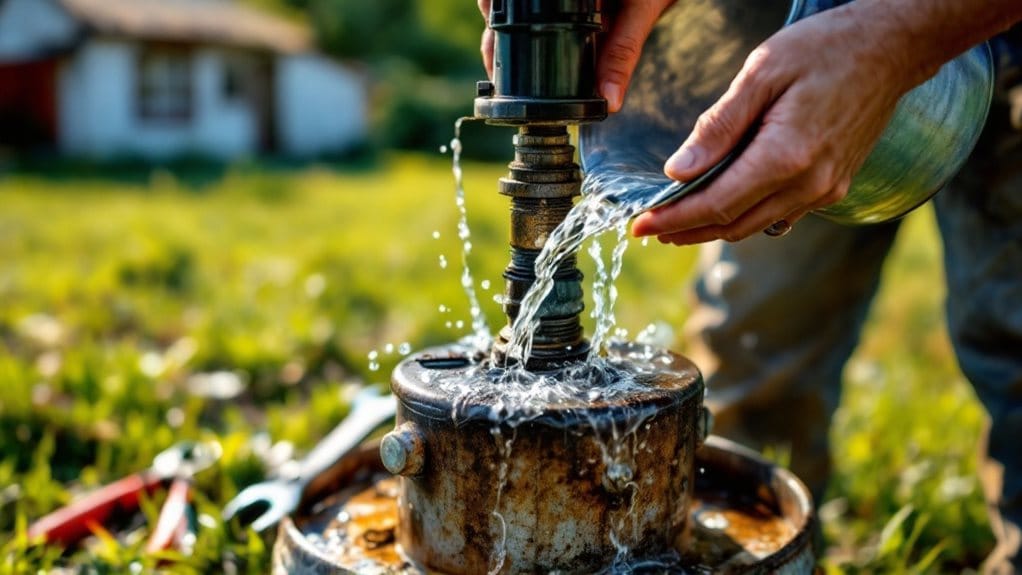
A pump that runs but moves nothing is one of the most common call-outs on any site, and nine times out of ten the cause is air. Knowing how to prime a pump properly, and knowing which pumps never need priming at all, saves a wasted afternoon and a burnt-out mechanical seal.
This guide covers priming for every pump type we supply: standard surface centrifugal pumps, shallow well jet pumps, self-priming and petrol engine pumps, and submersible, sump and borehole pumps. It is written for facilities teams, contractors and anyone responsible for keeping water moving. You will find the step-by-step method for each type, the reasons a pump loses its prime, and a fault-finding table for pumps that refuse to pick up.
What Priming a Pump Actually Means
A centrifugal pump moves liquid by spinning an impeller that throws water outwards and creates low pressure at the eye of the impeller. That low pressure only pulls more water in if the casing is already full of liquid. Air is roughly 800 times less dense than water, so an impeller spinning in air cannot create enough suction to lift water up the suction pipe.
Priming is the job of filling the pump casing, and on most installations the suction pipe as well, with liquid before the pump starts. Once the casing is full and the air is out, the impeller can do its job and the pump will keep itself full for as long as it runs.
Why Running an Unprimed Pump Causes Damage
The mechanical seal on almost every centrifugal pump relies on the pumped liquid to lubricate and cool its faces. Run the pump dry and those faces overheat in seconds, which leads to cracked seal faces, leaks along the shaft and, if water then reaches the motor, a rewind. Plastic impellers and wear rings can also distort from the heat.
Does Your Pump Need Priming?
The first question is whether your pump needs priming at all. Many people searching for how to prime a pump actually have a submersible pump with an air lock, which needs a different fix. Use the table below to find your pump type.
| Pump type | Needs priming? | What to do |
|---|---|---|
| Standard surface centrifugal pump (suction lift) | Yes, every time it loses its water | Fill the casing and suction pipe through the priming plug; fit a foot valve so it stays primed |
| Surface pump with flooded suction (water level above the pump) | Only the first time | Open the suction valve and vent the air until water runs from the vent |
| Shallow well jet pump | Yes | Fill casing and suction line through the prime port, often several times |
| Self-priming surface pump | First fill only | Fill the casing once; the pump clears air from the suction line itself |
| Petrol or diesel engine pump | First fill only (most are self-priming) | Fill the casing through the priming cap before every start after draining |
| Submersible sump, drainage or sewage pump | No | If it runs but does not pump, clear the air lock (see below) |
| Submersible borehole pump | No | Check water level, non-return valve and dry-run protection instead |
How to Prime a Surface Centrifugal Pump
This is the classic case: a standard end-suction or multistage pump sitting above the water source and lifting water up a suction pipe. Booster pumps, irrigation pumps and many process pumps fall into this group. The diagram shows the parts you will be working with.
Step-by-Step Priming Method
Work through these steps in order. They apply to most standard surface pumps, but always check the manufacturer's instructions for your model first.
- Isolate the power. Switch off and lock off the supply at the isolator so nobody can start the pump while the priming plug is out.
- Close the discharge isolation valve. This stops water you pour in from running straight out through the outlet, and lets the pump build pressure quickly when it starts.
- Open any suction valve fully. A partly closed suction valve restricts flow and makes priming slower and less reliable.
- Remove the priming plug on the top of the casing. Some pumps have a separate air vent screw as well; open both.
- Fill with clean water until the casing and suction pipe are full and water stands at the plug opening with no more air bubbles rising. On a long suction pipe this can take many litres, because the foot valve is holding the whole column.
- Refit the plug and tighten it. Use PTFE tape on the thread if it has been leaking, because an air leak here will undo all the work.
- Start the pump and open the discharge valve slowly. Watch the pressure gauge. Pressure should build within a few seconds, and you can then open the valve to its normal running position.
If the pressure does not build, stop the pump, top up the casing and try again. Two or three attempts are normal on a dry suction line. More than that points to a leak or a fault, covered in the troubleshooting section below.
Priming a Pump With Flooded Suction
When the water level is above the pump, such as a pump drawing from the bottom of a break tank, gravity does most of the work. Open the suction isolation valve, open the casing vent and let water push the air out. Once a steady stream of water with no air comes from the vent, close it and start the pump. This only needs doing after installation or after the pump has been drained for maintenance.
How to Prime a Shallow Well Jet Pump
Jet pumps are surface pumps that use a venturi to boost their suction, and they are common on shallow wells and older domestic water systems. They need priming in the same way as a centrifugal pump, but the jet assembly and long suction pipe usually hold more air, so priming takes longer.
Fill the casing through the prime port until it overflows, refit the plug and run the pump for no more than 30 seconds. If it has not picked up, stop, refill and repeat. It is normal to need several cycles before the suction line is full. A jet pump that will not prime after four or five attempts almost always has an air leak in the suction pipe or a foot valve that is not holding.
Shallow well pumps are also limited by suction lift. At sea level the practical limit is around 7 to 8 metres from the water level to the pump, and less in warm water or with long suction runs. If the water has dropped below that, no amount of priming will help. Our guide to pump suction lift and NPSH explains how to work out the real limit for your installation, and choosing the right well pump covers when a submersible is the better option.
Self-Priming and Engine-Driven Pumps
A self-priming pump has a casing designed to hold a reserve of water after it stops. When it starts again, it recirculates that water to drag air out of the suction pipe until water arrives. It still needs filling once before its first start, and again any time the casing has been drained.
To prime a self-priming pump, remove the fill plug on top of the casing, fill until water reaches the plug, refit it and start the pump. Expect a delay before water arrives: the higher the suction lift and the longer the suction hose, the longer it takes. Our self-priming pumps guide explains how they work and where they make sense.
Petrol and Diesel Engine Pumps
Most portable engine-driven water pumps, including clear water, semi-trash and trash pumps, are self-priming. The method is the same: fill the pump body through the priming cap, refit the cap and start the engine. Never start the engine with an empty pump body, because the seal will be damaged within seconds, and keep the suction hose connections tight because an air leak at the coupling is the most common reason these pumps will not pick up.
Submersible, Sump and Borehole Pumps: No Priming Needed
Submersible pumps sit in the water they pump, so the impeller is always flooded and they never need priming. People often search for how to prime a submersible pump when the real problem is an air lock: the pump runs, but a pocket of air trapped between the impeller and the non-return valve stops water from moving.
Clearing an Air Lock on a Sump or Drainage Pump
Air locks are most common on pumps that have run the pit dry, or that were lowered into the water while already connected to a discharge pipe with a non-return valve. Try these fixes in order:
- Switch off, lift the pump slightly and tilt it so trapped air can escape from the volute, then lower it again.
- Loosen the union between the pump and the non-return valve to let the air out, then retighten it once water appears.
- For a permanent fix, drill a small air relief hole of about 3 to 5 mm in the discharge pipe, between the pump outlet and the non-return valve and below the water line. Many manufacturers recommend this, and the small loss of flow back into the pit is negligible.
When a Borehole Pump Delivers No Water
A submersible borehole pump that runs without delivering water is not unprimed. The usual causes are the water level drawing down below the pump intake, a stuck or leaking non-return valve, a split in the rising main, or dry-run protection that has tripped. Check the static and pumping water levels first. If the borehole is struggling to keep up, the answer is a lower setting depth or a smaller pump rather than priming. Our guide to selecting a well and borehole pump covers sizing a pump to the yield of the borehole.
Why a Pump Will Not Prime or Keeps Losing Prime
If you have followed the steps and the pump still will not pick up, or it primes but loses its prime overnight, work through this table. The causes are listed roughly in the order we see them.
| Symptom | Likely cause | Fix |
|---|---|---|
| Primes, then loses prime when stopped | Foot valve or non-return valve not seating | Clean or replace the foot valve; check for debris under the flap |
| Will not pick up; air bubbles in the casing | Air leak in suction pipe, fitting or priming plug | Tighten joints, re-tape threads, check hose clips and gaskets |
| Runs, builds little or no pressure | Suction lift too high for the pump | Lower the pump, use a submersible, or reduce suction losses |
| Will not prime after installation | Suction pipe rises and falls, trapping air | Re-lay the suction pipe so it rises steadily towards the pump |
| Three-phase pump will not build pressure | Motor running backwards | Have an electrician swap two phases and check rotation |
| Primes slowly, poor flow, noisy | Blocked strainer or partly closed suction valve | Clear the strainer and open the valve fully |
| Loses prime with hot liquid | Liquid vaporising on the suction side | Reduce suction lift or provide flooded suction |
Noise that sounds like gravel passing through the pump after it has primed is usually cavitation rather than a priming problem. Our article on pump cavitation explains the difference and how to stop it.
Common Priming Mistakes
Most failed priming attempts come down to a handful of avoidable errors:
- Filling the casing but not the suction pipe. On a suction lift installation the whole column must be full, or the water in the casing simply drains down the pipe.
- Leaving the discharge valve wide open on a standard centrifugal pump, so the water poured in runs out of the outlet.
- Running the pump dry for minutes waiting for it to pick up, which damages the mechanical seal.
- Using a suction hose that collapses under vacuum. Suction lines need reinforced hose rated for suction, not lay-flat delivery hose.
- Ignoring a slow loss of prime. A pump that needs re-priming every few days has a leaking foot valve or an air leak that will get worse.
Recommended Pumps from AES Rewinds
If priming is a constant problem on your site, the pump may be the wrong type for the job. At AES Rewinds we stock a wide range of pumps for industrial and commercial applications, including models that avoid priming altogether.
Browse our full range:
- Self-priming pumps for dirty water, trash, sea water and transfer duties
- Petrol engine water pumps for sites without power
- Well and borehole pumps for wells too deep for a surface pump
- Surface mounted pumps for tanks and flooded suction installations
Our team can help you choose a pump that suits your suction conditions. Contact us for expert advice on priming problems and pump selection.
Frequently Asked Questions
How long does it take to prime a pump?
A standard surface pump with a full suction line primes in seconds once the casing is filled. A self-priming pump on a high suction lift can take a minute or more to clear the air from the suction hose. If a surface pump has not built pressure within about 30 seconds, stop it and refill rather than letting it run dry.
Do submersible pumps need to be primed?
No. A submersible pump sits in the water, so the impeller is always flooded. If it runs but does not pump, it usually has an air lock between the pump and the non-return valve. The air lock section above explains how to clear it.
How do you prime a pump with a pressure tank?
Isolate the pump, open a tap to release pressure from the tank and pipework, then prime the pump casing as normal through the priming plug. Once the pump has built pressure, close the tap and let the pressure switch take over. Check the tank pre-charge while the system is empty, as a flat tank causes rapid cycling.
Why does my pump keep losing its prime?
Almost always because water is draining back down the suction pipe when the pump stops. A worn or blocked foot valve, a leaking non-return valve or an air leak on the suction side are the usual causes. See the troubleshooting table for the full list.
Can I prime a pump with hot water?
Use cold, clean water wherever possible. Hot water vaporises more easily under suction, which makes priming harder and can cause cavitation once the pump is running.
What is a foot valve and do I need one?
A foot valve is a non-return valve with a strainer, fitted to the bottom of the suction pipe. It holds water in the suction line when the pump stops, so a standard surface pump stays primed between runs. Any surface pump working on suction lift without self-priming capability needs one.
Do I need to prime a self-priming pump?
Yes, but only once. The casing must be filled before the first start and after it has been drained. After that, the pump keeps enough water in the casing to clear air from the suction line by itself.
Key Takeaways
- Only surface pumps need priming. Submersible, sump and borehole pumps never do, so a submersible that runs without pumping has an air lock or a supply problem.
- To prime a surface pump, fill both the casing and the suction pipe, vent the air, then start against a closed or partly closed discharge valve.
- Stop any pump that has not built pressure within about 30 seconds; dry running destroys mechanical seals.
- A pump that keeps losing its prime has a leaking foot valve, non-return valve or suction joint.
- Self-priming and engine pumps still need their casing filled before the first start.
Related Articles
- Self-Priming Pumps: How They Work and Their Applications: when a self-priming pump is the better choice.
- Pump Suction Lift and NPSH Explained: work out how far your pump can really lift.
- Pump Cavitation: Causes, Warning Signs and Prevention: the noise that is often mistaken for a priming fault.
- Choosing the Right Well Pump: surface, jet and submersible well pumps compared.
- How to Prepare Your Pumps for Winter: draining and re-priming pumps around the cold months.