
Pentax DTR Submersible High Head Sewage Grinder Pumps
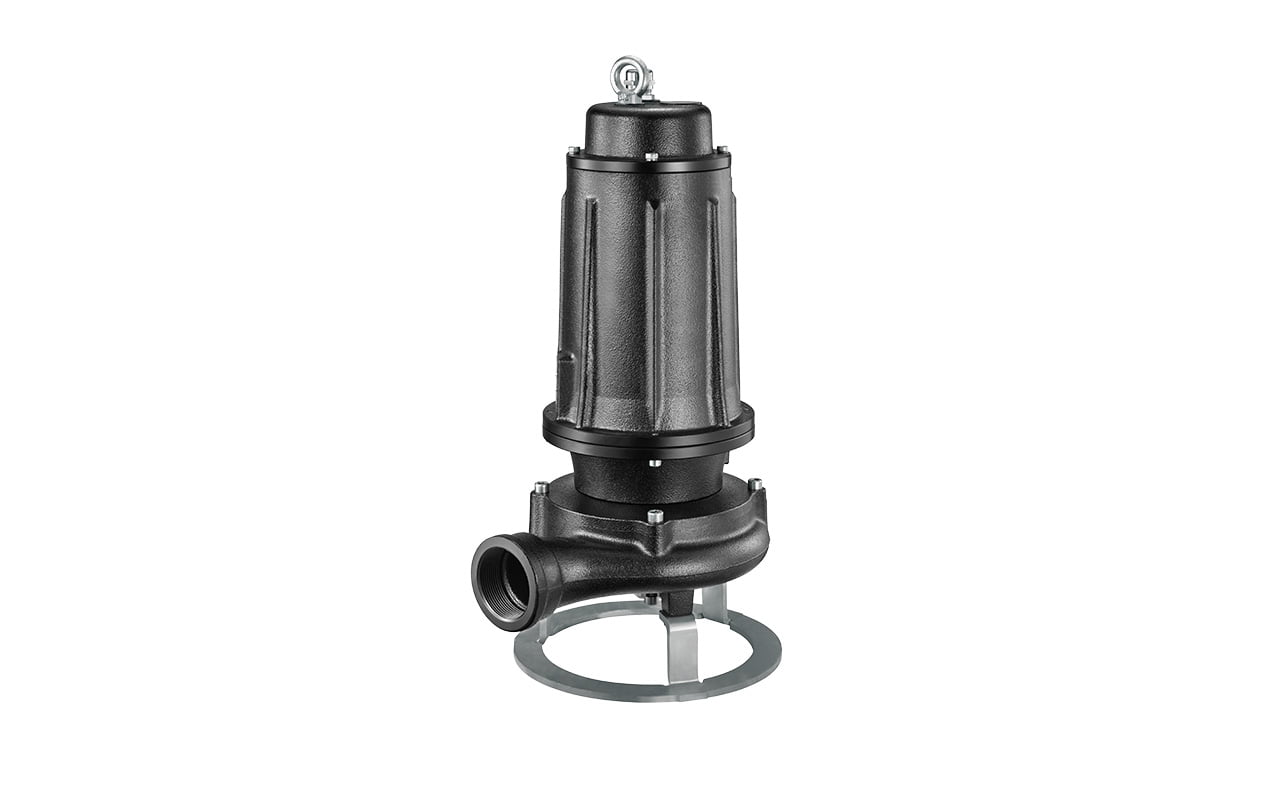
The Pentax DTR and DTRT submersible high head sewage grinder pumps are for sewage that has to be pushed a long way up. Pentax describes the range as drainage pumps that guarantee high head, fitted with an open impeller and a grinder that shreds suspended solids, including textile and filament fibres, so they do not block the pump. Across nine models, maximum head runs from 19.4 metres on the smallest pump to 54.6 metres on the DTRT 1000.
Every model has a cast iron pump body and impeller, a treated stainless steel grinder, an AISI 304 stainless steel shaft and a double mechanical seal with an oil barrier. The two-pole motor is rated for immersion to 20 metres and liquids from 0 to 40 °C. These are bare pumps with no float switch, so they run under a control panel or level control of your choosing.
How the DTR and DTRT names work
DTR models are single-phase 230v and DTRT models are three-phase 400v. The number is the motor rating in horsepower times 100, so the DTRT 400 is a 4 HP (3 kW) pump and the DTRT 1000 a 10 HP (7.5 kW) pump. The 150 and 200 sizes come in both supplies; from the DTRT 300 upwards the range is three-phase only.
Outlet. The DTR 150, DTR 200 and DTRT 150 to 300 have a 2″ G threaded outlet. The DTRT 400 and 550 have a DN50 flange and the DTRT 750 and 1000 a DN65 flange, both to UNI PN10.
Picking a size. Work out the total head at the flow you need, then choose the smallest pump that still delivers it. Head drops as flow rises, so the table gives Pentax’s head at 150 and 300 litres per minute as well as the maximum. For lighter single-phase duties, the JS GS grinder range covers 110v and 230v supplies.
| Model | Supply | Motor (kW) | Current (A) | Outlet | Max Head (m) | Head at 150 l/min (m) | Head at 300 l/min (m) |
|---|---|---|---|---|---|---|---|
| DTR 150 | 230v 1~ | 1.1 | 11.5 | 2″ G | 19.4 | 16.0 | 9.9 |
| DTR 200 | 230v 1~ | 1.5 | 13.6 | 2″ G | 22.1 | 19.1 | 13.4 |
| DTRT 150 | 400v 3~ | 1.1 | 4.4 | 2″ G | 19.4 | 16.0 | 9.9 |
| DTRT 200 | 400v 3~ | 1.5 | 5.1 | 2″ G | 22.1 | 19.1 | 13.4 |
| DTRT 300 | 400v 3~ | 2.2 | 5.8 | 2″ G | 26.1 | 23.3 | 18.2 |
| DTRT 400 | 400v 3~ | 3.0 | 7.5 | DN50 flange | 33.5 | 28.5 | 21.6 |
| DTRT 550 | 400v 3~ | 4.0 | 9.2 | DN50 flange | 38.6 | 33.9 | 27.6 |
| DTRT 750 | 400v 3~ | 5.5 | 13.9 | DN65 flange | 47.8 | 42.7 | 36.1 |
| DTRT 1000 | 400v 3~ | 7.5 | 15.5 | DN65 flange | 54.6 | 49.2 | 42.7 |
Maximum head is at zero flow. Figures are from Pentax’s 50 Hz performance data; click through to any model for its full specification.
Showing all 9 results

19.4 m max head · 230v
Single-phase 230v Pentax high head sewage grinder pump with a 1.1 kW motor (11.5 A) and a 2" G ...Read More£944.74 +VAT
22.1 m max head · 230v
Single-phase 230v Pentax high head sewage grinder pump with a 1.5 kW motor (13.6 A) and a 2" G ...Read More£946.12 +VAT
19.4 m max head · 400v
Three-phase 400v Pentax high head sewage grinder pump with a 1.1 kW motor (4.4 A) and a 2" G ...Read More£932.32 +VAT
22.1 m max head · 400v
Three-phase 400v Pentax high head sewage grinder pump with a 1.5 kW motor (5.1 A) and a 2" G ...Read More£961.99 +VAT
26.1 m max head · 400v
Three-phase 400v Pentax high head sewage grinder pump with a 2.2 kW motor (5.8 A) and a 2" G ...Read More£965.44 +VAT
33.5 m max head · 400v
Three-phase 400v Pentax high head sewage grinder pump with a 3 kW motor (7.5 A) and a DN50 flanged ...Read More£1,414.63 +VAT
38.6 m max head · 400v
Three-phase 400v Pentax high head sewage grinder pump with a 4 kW motor (9.2 A) and a DN50 flanged ...Read More£1,440.16 +VAT
47.8 m max head · 400v
Three-phase 400v Pentax high head sewage grinder pump with a 5.5 kW motor (13.9 A) and a DN65 flanged ...Read More£1,994.23 +VAT
54.6 m max head · 400v
Three-phase 400v Pentax high head sewage grinder pump with a 7.5 kW motor (15.5 A) and a DN65 flanged ...Read More£2,068.06 +VAT
Where to Use Pentax DTR High Head Grinder Pumps
Pentax lists septic tank emptying and residential sumps among the uses for the range, along with industrial, civil and livestock sewage wherever suspended solids need to be broken down. In practice the DTR earns its place when the discharge point is high or far away: a basement or below-ground plant room lifting to a sewer at street level, a house or annexe pumping up a long drive, or a commercial site sending effluent up a rising main to a distant manhole. Pentax also states that the grinder lets the pump handle sewage containing textile or filament fibres, which suits sumps where rags and similar material regularly turn up.
Size the pump on total head, which is the vertical lift plus the friction loss in the pipework at your chosen flow. On a long run the friction part can be larger than the lift itself. Our guides to pump head and flow rate and reading a pump curve show how to work it out, and how a sewage grinder pump works explains what the grinder does. If you need three-phase power in a lighter duty, the JS GST grinder range and the Oliju SGR grinder pumps are worth comparing.
Frequently Asked Questions
What is the difference between the Pentax DTR and DTRT?
The T stands for three-phase. DTR models run on a 230v single-phase supply and DTRT models on 400v three-phase. The DTR 150 and DTRT 150 share the same 1.1 kW hydraulics, as do the DTR 200 and DTRT 200 at 1.5 kW. Anything from the DTRT 300 upwards is three-phase only.
How much head can a DTRT pump reach?
Pentax gives a maximum head of 54.6 metres for the DTRT 1000, 47.8 metres for the DTRT 750 and 38.6 metres for the DTRT 550. Those figures are at zero flow. At 300 litres per minute the same pumps still deliver 42.7, 36.1 and 27.6 metres, which is the kind of figure to compare against your own total head.
Do the single-phase DTR models need a capacitor?
Yes. Pentax specifies a run capacitor of 35 µF for the DTR 150 and 50 µF for the DTR 200, plus an 80 µF start capacitor with a circuit breaker. Call us before ordering and we will confirm what you need for your installation.
Can a DTR pump run automatically?
Not on its own, as there is no float switch on the pump. For automatic operation, wire it through a control panel with level sensing or float switches; our float switch guide explains the options.
What outlet connection do the DTRT pumps have?
The DTR 150, DTR 200 and DTRT 150 to 300 have a 2″ G threaded outlet. The DTRT 400 and 550 have a DN50 flange and the DTRT 750 and 1000 a DN65 flange, both drilled to UNI PN10. Pentax lists DN50 and DN65 quick-coupling kits as accessories for the flanged models.
What are the operating limits?
Pentax rates the range for liquids from 0 to 40 °C and immersion to a maximum depth of 20 metres. The grinder is meant for the soft solids and fibres found in sewage, so ask us before pumping water carrying sand, gravel or other abrasive material. These pumps are not for flammable liquids, oils or chemicals.
For help matching a DTR or DTRT model to your head, pipe run and power supply, call the AES Rewinds team on 01252 515169 or email sales@aesrewinds.com. You can also browse all sewage pumps or the wider Pentax range.
Free, independent advice
Need help choosing? Ask our team
Not sure it is the right pump or motor for the job? Send us a question and our team will reply, or call us now. We have been supplying, repairing and rewinding pumps since 1948.
Monday to Friday, 8.30am to 5.30pm
Send us a question
We reply within one working day.