
JS RSD-400 Residue Puddle Pumps
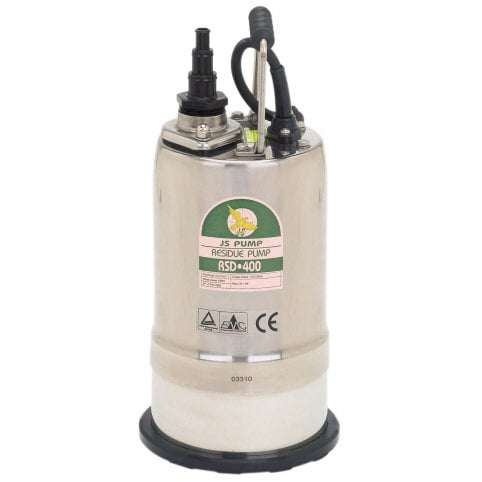
The JS RSD-400 is a professional residue pump, often called a puddle sucker, built to take flood water down to approximately 1 mm. A standard submersible stops drawing once the water drops below its intake and leaves a wet floor behind; the RSD-400 keeps going until only a film is left, and whatever remains can be swept straight into the pump. That makes it the pump to finish the job in flooded basements, lift pits, plant rooms and tanks.
It is built for heavy duty use. The outer case, motor case and shaft are stainless steel, while the motor lid, pump casing and volute are cast iron. Twin mechanical seals with carbon ceramic and silicon carbide faces run in a lubricated chamber, and a cushioned rubber bottom plate protects both the pump and the floor or tank base it stands on.
RSD-400 110v or 230v?
Both RSD-400 models share the same 0.4 kW motor and the same performance: up to 190 litres per minute and a maximum head of 11.5 metres. The only choice is the supply. Pick the 230v version for mains sockets in buildings, and the 110v version if you work from a site transformer, as most contractors and restoration teams do.
Each pump has a 1¼” BSP female outlet with a stepped hose tail for 25 mm, 19 mm or 15 mm hose, and comes with 10 metres of power cable. A non-return valve on the suction side stops water running back out of the hose when the pump stops. The RSD-400 has to be primed if you use it in shallow water, so do this before you switch on.
Both models are manual and run whenever the power is on. For unattended running, add the Crab puddle sensor or a MATIC Utility 15 panel with its puddle sensor.
| Model | Supply | Outlet | Max Flow (l/min) | Max Head (m) | Motor (kW) | Current (A) | Code |
|---|---|---|---|---|---|---|---|
| RSD-400 230v | 230v | 1¼” BSP female | 190 | 11.5 | 0.4 | 2.8 | 012-400 |
| RSD-400 110v | 110v | 1¼” BSP female | 190 | 11.5 | 0.4 | 5.6 | 012-402 |
Flow, head, motor and current are JS Pumps’ published figures for the RSD-400. Click through to either model for full specifications and the performance curve.
Showing all 2 results

190 l/min · 11.5 m · 230v
JS RSD-400 230v professional residue puddle pump that drains water down to approximately 1 mm. Up to 190 l/min ...Read More£248.53 +VAT
190 l/min · 11.5 m · 110v
JS RSD-400 110v residue puddle pump for site transformers, draining water down to approximately 1 mm. Up to 190 ...Read More£249.91 +VAT
Where to Use the JS RSD-400
Use the RSD-400 wherever water has to come off a hard, flat surface rather than out of a sump. Typical jobs are flooded basements and cellars after the main pump-out, lift shafts and pits, plant rooms, underground car parks, tank bases and floor slabs on site. Flood restoration and facilities teams often run it after a larger drainage pump: the big pump shifts the bulk of the water, then the RSD-400 takes the floor down to a damp film that dries out far faster.
Its 11.5 metre maximum head lets it push water up out of a basement and along a hose to a drain, but flow falls as the lift and hose length increase, so check the curve on the product page against your job. Our guide to pump head and flow rate explains how to read it, and the puddle pump guide covers how residue pumps differ from ordinary submersibles.
The RSD-400 sits at the professional end of our puddle pumps. For lighter domestic jobs in rooms, garages and cellars, the plastic-bodied JS RSD 150 Puddle Buddy is smaller and lighter to carry. The Koshin Ponstar PXL is the other professional residue pump we stock, with a polyurethane rubber pump body. If the water is deep and you need to move volume quickly, start with a JS heavy duty contractor pump and finish with the RSD-400. For a wider look at the options, see our guide to flood pumps.
Frequently Asked Questions
How low does the RSD-400 pump water?
JS Pumps states that the RSD-400 drains water down to approximately 1 mm. The thin film that remains can be swept towards the pump with a squeegee or broom and picked up, so the floor is left close to dry.
Does the RSD-400 need priming?
Yes, when it is used in shallow water, which is how a residue pump is normally used. JS Pumps states that the RSD-400 has to be primed in that situation, so prime it before you switch on. The non-return valve on the suction side then helps stop water draining back out when the pump stops.
Can the RSD-400 run automatically?
Both RSD-400 models are manual, so they run whenever they are switched on. For automatic operation, fit the Crab low level sensor, which sits on the floor, detects water and starts and stops the pump after adjustable delays without a separate control panel. The alternative is a MATIC Utility 15 panel with the MATIC puddle sensor. You can find more options under pump controls.
What is the difference between the RSD-400 and the RSD 150 Puddle Buddy?
The RSD-400 is the professional model, with a 0.4 kW motor, stainless steel outer case, cast iron pump casing and a 1¼” outlet. The RSD 150 Puddle Buddy is a lighter, plastic-bodied pump with a smaller motor, intended for domestic clean water jobs. Choose the RSD-400 for regular site, commercial or restoration work.
What can the RSD-400 pump?
It is designed for clean water drainage and nuisance water, with a maximum solids size of 2 mm. It is not suitable for sewage, sludge, silt-heavy water or liquids containing oil or chemicals. For dirty site water with grit, use a contractor drainage pump instead.
If you would like help choosing between the RSD-400 110v and 230v, or setting one up for automatic use, call the AES Rewinds team on 01252 515169 or email sales@aesrewinds.com. You can also browse all puddle pumps.
Free, independent advice
Need help choosing? Ask our team
Not sure it is the right pump or motor for the job? Send us a question and our team will reply, or call us now. We have been supplying, repairing and rewinding pumps since 1948.
Monday to Friday, 8.30am to 5.30pm
Send us a question
We reply within one working day.