
JS RSD 150 Puddle Buddy Low Level Residue Pumps
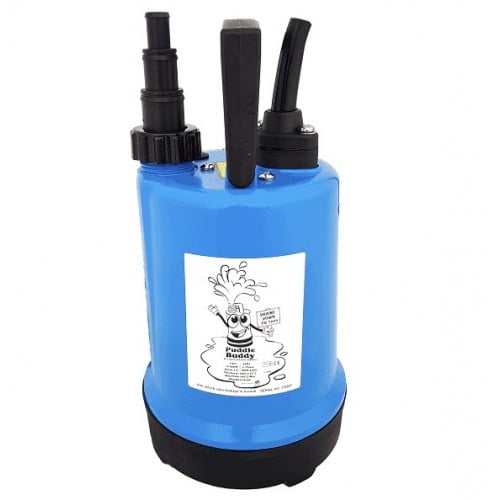
The JS RSD 150 Puddle Buddy is a compact, portable residue pump for clearing the last of the clean water from flooded floors in homes and light commercial buildings. JS designed it for rooms, garages and cellars, and its catalogue says it starts pumping at around 2 mm of water. It comes in two versions: 230v for household sockets and 110v for site transformers.
A residue pump, also called a puddle pump or puddle sucker, draws water in at floor level, so it keeps working long after an ordinary submersible sump pump has lost suction. The Puddle Buddy has a plastic pump body and impeller, which keeps it to 5 kg, and an anti-air lock valve that helps it in shallow water. It has a single mechanical seal and an oil seal, a 1 inch male top outlet with a 1″, ¾” and ½” step adapter hose tail, and 10 metres of power cable.
Which RSD 150 Puddle Buddy do you need?
Both versions have the same hydraulics: up to 100 litres per minute and up to 6.5 metres of head from a 0.15 kW motor. The only choice is the power supply. The 230v model (012-150) plugs into a standard socket and draws 1.4 amps. The 110v model (012-152) is for building sites and workplaces where portable tools must run from a 110v transformer, and draws 3.0 amps.
Both are manual pumps, so they run whenever the power is on. For automatic running on the 230v model, add The Crab low level sensor probe, which sits on the floor beside the pump and switches it on and off as water appears and clears.
Is the Puddle Buddy the right size of puddle pump?
The RSD 150 is rated for domestic duty and light commercial use with clean water only, and its maximum solids size is 1 mm. For contractor work, larger flooded areas or more lift, look at the stainless steel cased JS RSD-400 residue puddle pumps or the Koshin Ponstar PXL professional residue pumps.
| Model | Supply | Outlet | Max Flow (l/min) | Max Head (m) | Motor (kW) | Current (A) | Weight (kg) | Code |
|---|---|---|---|---|---|---|---|---|
| RSD 150 Puddle Buddy 230v | 230v single phase | 1″ | 100 | 6.5 | 0.15 | 1.4 | 5 | 012-150 |
| RSD 150 Puddle Buddy 110v | 110v single phase | 1″ | 100 | 6.5 | 0.15 | 3.0 | 5 | 012-152 |
Maximum flow is at zero head and maximum head is at zero flow, so a working pump delivers less of each. Click through to either model for the full performance curve and details.
Showing all 2 results

100 l/min · 6.5 m · 230v
JS RSD 150 Puddle Buddy 230v residue pump for clearing clean water from flooded rooms, garages and cellars, starting ...Read More£145.03 +VAT

100 l/min · 6.5 m · 110v
JS RSD 150 Puddle Buddy 110v residue pump for site transformers, drawing 3.0 A. Up to 100 l/min and ...Read More£145.03 +VAT
Where to Use the RSD 150 Puddle Buddy
The Puddle Buddy is at its best after a domestic leak: a burst pipe, a washing machine that has flooded the kitchen, or an overflowing toilet. Stand it on the floor at the lowest point, run a hose to a drain or outside, and it clears standing water far faster than a mop. It also suits garages, cellars and utility rooms that take on a little water in heavy rain. Our guide to puddle pumps explains how residue pumps differ from ordinary submersible pumps.
For deeper flooding, use a larger submersible pump to remove the bulk of the water first, then finish with the Puddle Buddy. Our guide to flood pumps covers that approach. If the water has to go a long way or up a flight of stairs, check the head you need against the curve on the product page: our explainer on pump head and flow rate shows how to work it out. You can compare other options in our full range of puddle pumps.
Frequently Asked Questions
How shallow can the RSD 150 Puddle Buddy pump?
JS’s catalogue says the Puddle Buddy starts pumping at around 2 mm of water. Our supplier advises allowing about 5 mm of water for the pump to prime and start, so give it a little depth to get going if it does not pick up straight away. The anti-air lock valve helps it keep pumping once the water gets shallow.
Can I make the Puddle Buddy automatic?
Yes. The 230v model can be fitted with The Crab low level sensor probe, which rests on the floor and is factory set to start the pump 5 seconds after it detects water and stop it 30 seconds after the water clears. Fit a non-return valve on the outlet so the water in the hose does not run back when the pump stops. For the 110v model, call us to confirm the right control, or ask about the MATIC Utility 15 panel with its puddle sensor.
What is the difference between the RSD 150 Puddle Buddy and the RSD-400?
The RSD 150 is a light, plastic-bodied pump with a 0.15 kW motor for domestic duty and light commercial use. The RSD-400 is a heavier professional pump with a stainless steel outer case and a 0.4 kW motor. Choose the Puddle Buddy for occasional leaks at home and the RSD-400 for regular or commercial flood work.
Can the Puddle Buddy pump dirty water?
No. It is designed for clean water only and has a maximum solids size of 1 mm, so silt, grit or debris can block or wear it. For muddy water or water carrying solids, choose from our dirty water pumps instead.
What hose fits the RSD 150?
The pump has a 1 inch male top outlet and comes with a step adapter female hose tail that takes 1″, ¾” or ½” hose. The larger the hose, the less friction and the more water you get out, so use 1″ hose where you can. Hose and fittings are in our hose and accessories range.
Can the Puddle Buddy be used lying on its side?
No. JS states that these pumps must not be installed or left lying on their side. Always stand it upright on the floor.
For help choosing between the 230v and 110v Puddle Buddy, or setting one up for automatic running, call the AES Rewinds team on 01252 515169 or email sales@aesrewinds.com. You can also browse the full JS Pumps range.
Free, independent advice
Need help choosing? Ask our team
Not sure it is the right pump or motor for the job? Send us a question and our team will reply, or call us now. We have been supplying, repairing and rewinding pumps since 1948.
Monday to Friday, 8.30am to 5.30pm
Send us a question
We reply within one working day.