
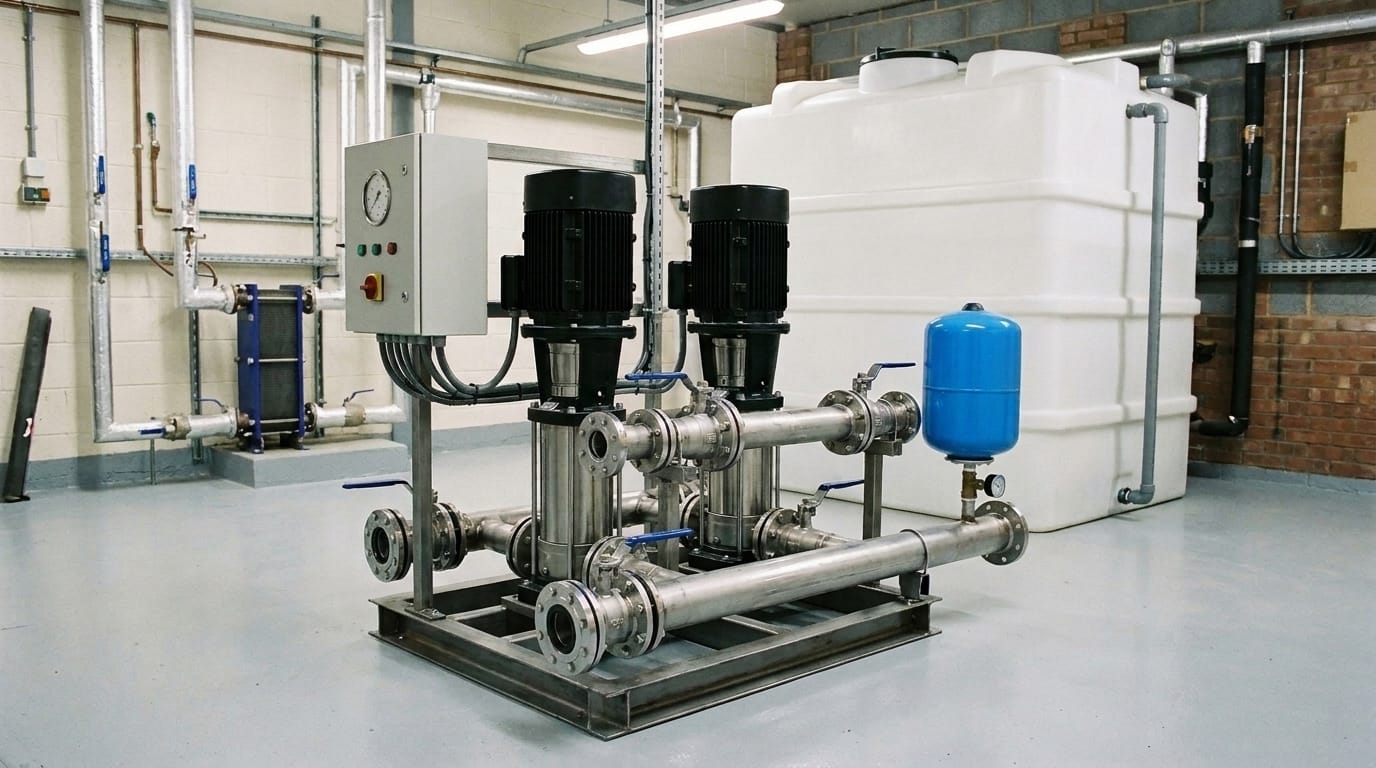
The ground floor flats have plenty of pressure, but by the fourth or fifth floor the showers run weak and the WC cisterns take minutes to fill. In most multi-storey buildings the answer is a cold water booster set: one or more pumps, drawing from a break tank, that deliver water at a steady pressure to every floor. Getting the booster set right means sizing it for the real peak demand, the full height of the building, and the pressure the lowest outlets can tolerate.
This guide is for facilities managers, building services engineers and contractors specifying or replacing a booster set in a block of flats, an office, a hotel or any building of three storeys or more. It covers how a booster set works, why a break tank is usually required, how to work out the duty point, when a building needs pressure zones, and how to choose between fixed speed, variable speed and duty/standby sets. If you are still diagnosing the problem, start with our guide to low water pressure in commercial buildings.
Why Multi-Storey Buildings Need Boosting
Every metre of height costs roughly 0.1 bar of pressure. A mains supply arriving at 2 bar at ground level has, in theory, enough static pressure to lift water about 20 metres, but that is with nothing flowing. Once taps and showers open, friction in the service pipe and risers takes a large share of what is left, and water companies only have to provide a modest minimum at the boundary. The result is the familiar pattern of good pressure low down and poor pressure at the top.
Boosting is also often needed when a building is fed from a storage tank. Water leaving a tank at low level has almost no pressure of its own, so without a pump it can only reach outlets well below the tank. Our guide to testing water pressure and flow rate shows how to measure what the building actually receives before you size anything.
The 12 Litres per Minute Rule
Under the Water Supply (Water Fittings) Regulations 1999, you must notify the water supplier before installing a pump or booster that draws more than 12 litres per minute, whether it is connected directly or indirectly to the supply pipe. Almost every multi-storey booster set exceeds that. Water suppliers generally expect larger sets to pump from a break tank filled from the mains rather than directly from the supply pipe, which protects the public supply from backflow and stops the pump pulling down pressure for neighbouring properties.
How a Cold Water Booster Set Works
A packaged booster set combines pumps, controls and a pressure vessel on a common base. The diagram shows a typical arrangement serving a five-storey building from a basement plant room.
Break Tank and Air Gap
The mains fills the break tank through a float valve or solenoid, discharging above an air gap so that water in the tank can never siphon back into the public supply. The type of air gap sets the level of backflow protection. A Type AB air gap protects against Fluid Category 5, the highest risk category, which is why "Cat 5 booster sets" are specified where a building serves high-risk uses such as clinical areas, bin stores or food preparation alongside drinking water. The tank must be made from approved materials and sized so that water turns over regularly rather than standing.
Pumps, Pressure Sensor and Vessel
Most building booster sets use vertical or horizontal multistage pumps, because each stage adds pressure and several stages produce the high heads tall buildings need. A pressure transducer on the outlet manifold tells the controller what the system pressure is. When an outlet opens and pressure falls, the controller starts a pump, or speeds one up, until the set point is restored. A pressure vessel stores a small volume of pressurised water so that a dripping tap or a single WC refill does not start a pump every few seconds.
How to Size a Booster Set for a Multi-Storey Building
Booster set sizing comes down to two numbers: the peak flow the building will draw and the pressure the pumps must deliver at that flow. Together they give the duty point, which you then check against a pump curve.
Step 1: Estimate Peak Flow With Diversity
The most common sizing mistake is to add up the flow of every tap, shower and WC in the building as if they all ran at once. They never do. UK practice uses the loading unit method set out in CIBSE Guide G and the CIPHE Plumbing Engineering Services Design Guide, which gives each type of outlet a value and converts the total into a realistic design flow that allows for diversity. A block of 40 flats might have a theoretical maximum several times higher than the flow it will ever actually draw.
Oversizing is not a safe margin. An oversized set short-cycles at low demand, wastes energy and can make pressure control harder. Where the building already exists, logging real flow and pressure over a busy morning is worth doing before you commit to a duty point.
Step 2: Work Out the Pressure the Pumps Must Deliver
The pump discharge pressure has three parts:
- Static lift: the height from the water level in the break tank to the highest outlet, at about 0.1 bar per metre.
- Residual pressure at the highest outlet: the pressure the worst-placed fitting needs to work properly. Required outlet pressures vary from about 0.2 to 4 bar depending on the fitting, so check the most demanding shower or appliance on the top floor.
- Friction losses: the pressure lost through the riser, branches, valves, meters and filters at peak flow.
Our explainer on pump head and flow rate covers converting between bar and metres of head, and sizing pump discharge pipes explains how pipe bore drives friction loss. Use the calculator below for a first estimate of the duty pressure and to see whether the lower floors will need protecting.
Booster set pressure calculator
A first estimate of the pressure a booster set must deliver, and the pressure the lowest floor will see.
Uses 1 bar = 10.2 m of water. The lowest-floor figure ignores friction, so it shows the worst case at low flow. A guide only: final selection should be checked against the pump curve and the building's design calculations.
Step 3: Check the Duty Point Against the Pump Curve
With the peak flow and discharge pressure known, plot the duty point on the pump curves of the sets you are considering. The duty point should sit near the middle of the curve, not at the far right end where efficiency falls and NPSH requirements rise. Our guide to reading a pump curve walks through this, including how curves change for multi-pump sets.
Pressure Zones in Taller Buildings
A single booster set pressurising one riser works well for low-rise buildings, but height creates a problem. If the pumps deliver enough pressure for the top floor, the bottom floor gets that pressure plus the full height of the building. Grundfos guidance for zoned water supply aims to keep the minimum pressure at the top of each zone at about 1.5 to 2 bar and the maximum at the bottom of each zone at about 4 to 4.5 bar. Beyond that range, taps splash, fittings wear quickly and the risk of leaks rises.
There are three common ways to manage this:
- Pressure reducing valves (PRVs) on the lower floors or on each flat's supply. This is the simplest fix for buildings a little too tall for one zone.
- Separate zones with their own risers, each fed by its own booster set or by a set with outlets at different pressures. This is normal in taller residential and office buildings.
- A roof tank with a top-floor booster, where the upper floors are boosted and the floors below are fed by gravity from the roof tank.
The right choice depends on the building height, the number of floors and the space available for plant and risers. On a refurbishment, the existing riser layout usually decides it.
Choosing the Right Type of Booster Set
Once the duty point is known, the next decisions are how many pumps, how they are controlled, and how much resilience the building needs.
| Option | How it works | Best for |
|---|---|---|
| Single pump, fixed speed | Pump starts and stops on a pressure switch, with a vessel to reduce cycling | Small buildings where a short outage would be tolerable |
| Single pump, variable speed | Drive adjusts speed to hold a constant pressure | Small blocks where steady pressure matters and demand varies |
| Duty/standby | Two pumps alternate; the standby takes over on a fault | Most residential blocks and offices |
| Duty/assist/standby | Pumps share peak demand, with spare capacity for a failure | Larger buildings, hotels and high peak demand |
Variable Speed Control
Variable speed sets match pump speed to demand. Demand in a residential building swings from almost nothing overnight to a sharp morning peak, so a variable speed set uses noticeably less energy, holds pressure more steadily and starts and stops more gently than fixed speed pumps. For existing single pumps, a drive such as the VSD Buddy APM203 can convert a fixed speed pump to constant pressure operation.
Resilience and Hydraulic Shock
A building with no gravity fallback has no water at all when its booster set fails, so duty/standby should be the default for occupied buildings. Specify a low-level cut-out on the break tank to protect the pumps from running dry, and alarms that reach whoever is responsible for the building. Fast pump starts and stops can also create pressure surges, known as hydraulic shock, which strain joints and fittings in tall risers. Soft starting, variable speed control and correctly charged vessels all reduce the risk.
Common Mistakes When Boosting a Multi-Storey Building
Most booster sets that fail early or never perform well have one of these problems:
- Sizing on total outlet flow rather than diversified peak flow, which produces an oversized, short-cycling set.
- Ignoring pressure at the lowest floors, so ground floor flats get excessive pressure and leaking fittings.
- Pumping directly from the main without agreeing it with the water supplier, which can starve neighbouring properties and risks backflow.
- An oversized break tank with poor turnover, which lets water stand and creates a water quality risk.
- No standby pump in a building that has no other way of getting water to the upper floors.
Our article on choosing the right booster pump covers pump selection for smaller and single-building applications.
Recommended Booster Pumps from AES Rewinds
Looking for a booster pump or the pumps to build a booster set? At AES Rewinds, we stock a range of booster pumps suitable for commercial and residential buildings.
Browse our full range:
- Booster pumps for raising pressure in buildings
- Nocchi DHI horizontal multistage pumps, in AISI 316 stainless steel, 230 V or 400 V
- Controls, including pressure switches and controllers
Our team can help you work out a duty point and select pumps for your building. Contact us for expert advice on boosting water pressure in multi-storey buildings.
Frequently Asked Questions
What is a cold water booster set?
A packaged unit of one or more pumps, a controller, a pressure sensor and a pressure vessel, usually drawing from a break tank, that delivers cold water at a constant pressure to a building. It is the standard way to supply the upper floors of multi-storey buildings.
Do I need a break tank for a booster pump?
Almost always, for a multi-storey building. Water suppliers generally expect larger booster sets to draw from a break tank rather than directly from the supply pipe, and the tank's air gap provides the backflow protection the Water Fittings Regulations require. Any pump drawing more than 12 litres per minute must also be notified to the water supplier before installation.
What is a Cat 5 booster set?
A booster set whose break tank has a Type AB air gap, which protects the mains against Fluid Category 5, the highest backflow risk. It is specified where the boosted water also serves uses such as clinical areas, bin stores or food preparation.
How much pressure do I need at the top floor?
Enough for the most demanding fitting at peak flow. Requirements range from about 0.2 bar for some taps to 3 bar or more for some showers, so check the fittings actually installed. Zoned systems commonly aim for at least 1.5 to 2 bar at the top of each zone.
How many floors can one booster set serve?
One set can serve the whole building, but a single pressure zone becomes impractical once the lowest floors would see more than about 4 to 4.5 bar. Taller buildings use PRVs on lower floors or separate pressure zones, as covered in the pressure zones section.
Fixed speed or variable speed?
Variable speed for most multi-storey buildings. It holds pressure more steadily, uses less energy at low demand and reduces pressure surges. Fixed speed sets still suit small buildings with simple, steady demand.
Key Takeaways
- Each metre of height costs about 0.1 bar, which is why upper floors lose pressure first.
- Notify the water supplier before installing any pump drawing over 12 litres per minute, pump from a break tank, and use a Type AB air gap where Fluid Category 5 protection is needed.
- Size the set on diversified peak flow using the loading unit method, not on the total flow of every outlet.
- Duty pressure is static lift plus residual pressure at the top outlet plus friction losses.
- Keep the lowest floors to about 4 to 4.5 bar with PRVs or pressure zones, and use duty/standby with variable speed for occupied buildings.
Related Articles
- Low Water Pressure in Commercial Buildings: diagnosing the cause before you boost.
- How to Test Water Pressure and Flow Rate: measuring what the building really receives.
- How to Increase Water Pressure in Your Home: fixes for houses and single dwellings.
- How to Choose the Right Booster Pump: pump selection for smaller systems.
- How to Read a Pump Performance Curve: checking a duty point.