
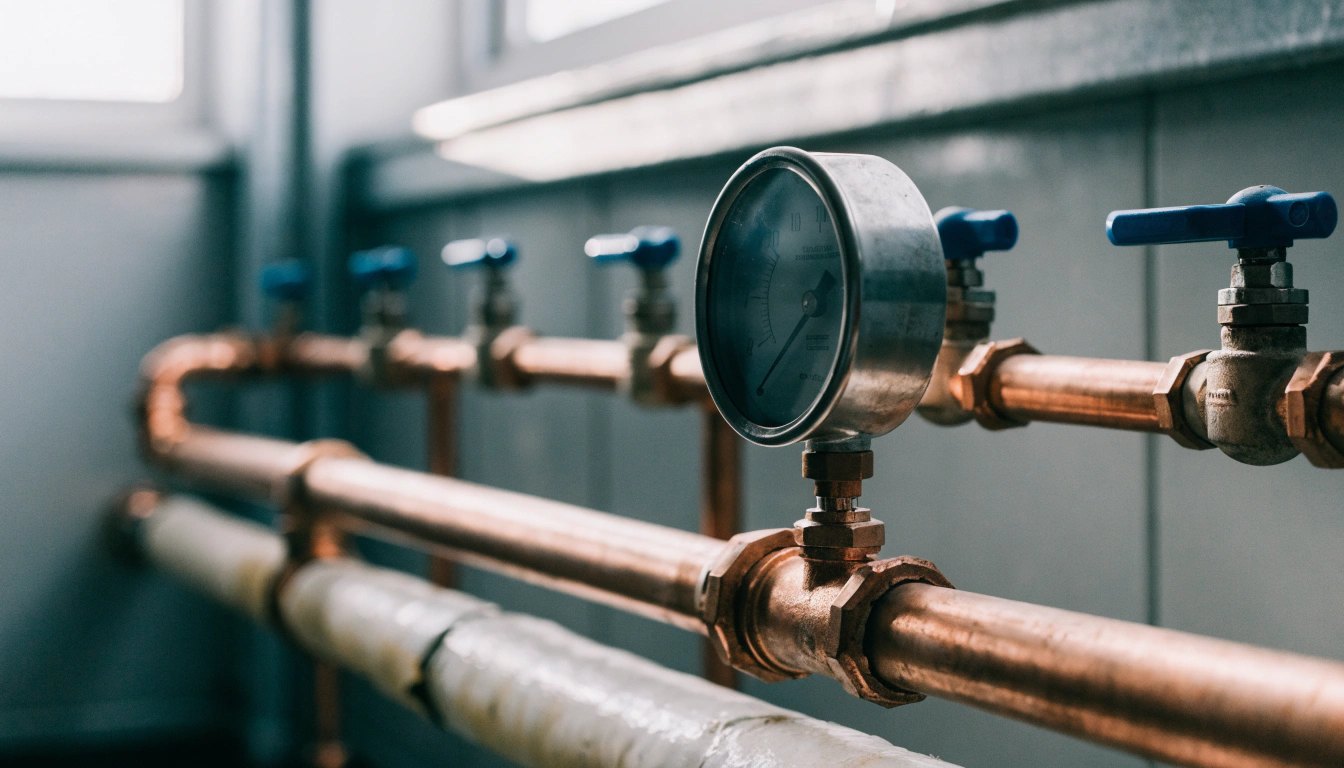
Before anyone specifies a booster set, replaces a pressure reducing valve or calls the water company, someone has to answer a simple question: what pressure and flow does this building actually have? Knowing how to test water pressure properly, and how to measure flow rate at the same time, is the difference between fixing the real fault and buying a pump that cannot cure it.
Most guides stop at a jug under the kitchen tap. That is a reasonable first check in a house, but it tells you very little about an office, a hotel, a school or a block of flats. This guide is written for facilities managers, contractors and maintenance engineers. It covers the equipment, the step-by-step test procedure for static and dynamic pressure, how to measure flow rate, a calculator that turns your readings into useful numbers, and what to record if you are sizing a pump.
If you already know you have a pressure problem and want to work out the cause, read our guide to low water pressure in commercial buildings alongside this one. The readings you take here feed straight into its diagnosis sequence.
Water Pressure and Flow Rate: Why You Need to Test Both
Pressure is the force pushing water through the pipework, measured in bar. Flow rate is the volume of water delivered over time, measured in litres per minute (l/min). A supply can have plenty of one and very little of the other, which is why a single gauge reading is never the whole picture.
Static and dynamic pressure
Static pressure is the reading with no water flowing anywhere downstream of the gauge. Dynamic pressure, also called residual or running pressure, is the reading while water is being drawn. The gap between the two shows how much pressure the supply and pipework lose when they are asked to deliver flow.
A small gap means the supply can deliver flow comfortably. A large gap points to a restriction: a narrow or long supply pipe, scale, a partly closed valve, a struggling main or heavy demand elsewhere. This is why a healthy night-time static reading can sit alongside daytime complaints.
Units and conversions
UK gauges usually read in bar, pump curves are drawn in metres of head, and some imported gauges and online guides still use psi. Use these conversions so every reading is compared on the same basis:
| Pressure (bar) | Head (m of water) | psi | kPa |
|---|---|---|---|
| 1.0 | 10.2 | 14.5 | 100 |
| 2.0 | 20.4 | 29.0 | 200 |
| 3.0 | 30.6 | 43.5 | 300 |
| 4.0 | 40.8 | 58.0 | 400 |
| 5.0 | 51.0 | 72.5 | 500 |
For flow, 1 litre per second equals 60 l/min, and 1 cubic metre per hour equals 16.67 l/min. Pump data sheets often quote m³/h, so it pays to convert your measured flow before comparing it with a curve. Our explainer on pump head and flow rate covers why pumps are rated in head rather than bar.
Equipment for a Water Pressure Test
You do not need specialist kit for a useful test, but the right gauge and fittings make the readings far more reliable. This is what a typical commercial test kit contains:
| Equipment | What it measures | Notes |
|---|---|---|
| Pressure gauge on a ¾” BSP tap connector | Static and dynamic pressure | Screws onto a washing machine valve or hose-threaded tap. Choose a 0 to 10 bar dial so normal readings sit mid-scale. |
| Gauge with a tee and flow-off valve | Dynamic pressure at a known flow | Lets you read pressure and collect water from the same point at the same time. |
| Graduated bucket (10 litres or more) and stopwatch | Flow rate by timed volume | A larger container gives a more accurate result than a 1 litre jug at commercial flow rates. |
| Water meter reading | Total flow over a period | Useful for whole-building flow and for spotting leaks when everything is off. |
| Pressure data logger | Pressure over 24 hours or longer | The best way to catch peak-time drops that a single visit misses. |
| Clamp-on ultrasonic flow meter | Flow in a pipe without cutting in | Usually hired. Accuracy depends on pipe material and a straight run either side. |
How to Test Water Pressure, Step by Step
The procedure below works for most commercial buildings supplied directly from the mains. If the building already has a booster set, take readings both upstream of it (on the incoming main) and downstream (on the boosted supply).
Choose your test points
One reading at the incoming main tells you what the supply delivers. One at the highest or furthest outlet tells you what users actually receive. The difference between them is what the building’s own pipework, height and fittings are costing you. Where you can, take readings at three points:
- As close to the main stop valve as possible. This is the reading to compare with the water company’s level of service.
- At the base of the main riser or booster outlet. This shows losses in the supply pipe, meter and any strainer or PRV.
- At the highest or most remote outlet. This is the reading that matches the complaints.
Step 1: Take a static reading
Close every outlet downstream of the test point and make sure no cistern, boiler, dishwasher or process is filling. Fit the gauge, open the test valve fully and wait for the needle to settle. Record the reading, the time and the test point.
In an occupied building it is hard to stop all draw-off, so note anything that might have been running. If the needle drifts slowly downwards with every outlet closed, check the meter: a meter that moves with nothing open usually means a leak.
Step 2: Take a dynamic reading at a measured flow
A dynamic reading only means something if you know the flow it was taken at. Fit the gauge on a tee with a flow-off valve, or open an outlet next to the gauge. Fully open the outlet, let the needle settle for 20 to 30 seconds, then record the pressure and measure the flow using the timed-volume method below.
Repeat at a second, higher flow if you can, for example by opening a second outlet. Two dynamic points plus the static reading let you sketch the supply curve and predict pressure at your design flow, which the calculator below does for you.
Step 3: Repeat at peak and off-peak times
Mains pressure varies through the day. United Utilities, for example, advises customers that pressure can dip during busy periods, roughly 7am to 9am and 4pm to 7pm (United Utilities, household supply checks). Test off-peak to judge the supply itself, and at the building’s own peak to see what occupants experience. A pressure logger left on the incoming main for a full week captures both without repeat visits.
Step 4: Correct for gauge height
A gauge reads the pressure at its own height. Every metre above the main costs about 0.098 bar, so a gauge on a tap 3 m above the incoming main reads roughly 0.3 bar lower than one at the stop valve. Note the height of each test point above the main so readings from different floors can be compared fairly.
How to Measure Water Flow Rate
Flow rate is the number that pump selection depends on, and it is easier to measure accurately than most people expect. Choose the method that suits the flow you are dealing with.
The timed-volume (bucket) method
Open the outlet fully, place a graduated container under it and time how long it takes to collect a known volume. Then divide the litres collected by the seconds taken and multiply by 60 to get litres per minute.
Collect at least 10 litres at commercial flow rates. With a 1 litre jug, a reaction-time error of half a second changes the result by around 7% at 9 l/min, and by far more at higher flows. Remove any aerator or flow regulator from the tap first, otherwise you are measuring the fitting rather than the supply.
Using the water meter
For whole-building or high flows, read the meter, open the outlets you want to test for a timed period of at least two minutes, then read it again. The difference in litres divided by the minutes gives the flow. The same meter, checked over 30 minutes with everything closed, is the quickest leak test you can do.
Simultaneous demand test
A single outlet test rarely reflects a busy building. To see how the system copes under load, open a realistic number of outlets on the same floor or riser at once, then measure pressure and flow at the most remote one. If its flow collapses while the others are open, the riser or branch is undersized, or the supply cannot deliver the building’s peak demand.
Water Pressure and Flow Test Calculator
Enter the figures from your test. The calculator converts your bucket test to l/min, l/s and m³/h, shows the pressure drop between static and dynamic readings, and estimates the pressure available at a target flow. Use readings taken at the same test point, at the same time.
Uses 1 bar = 10.197 m of water = 14.504 psi. The prediction assumes pressure loss rises with the square of flow, a common approximation for turbulent flow in pipework. Treat it as indicative, not as a design calculation.
Worked example: a three-storey surgery
At the incoming main, the static reading is 3.0 bar. With a test outlet fully open, 10 litres fill in 40 seconds and the gauge falls to 2.2 bar. The practice wants to know what the supply will give at 30 l/min, its estimated peak demand.
| Step | Calculation | Result |
|---|---|---|
| Measured flow (l/min) | 10 ÷ 40 × 60 | 15 l/min |
| Pressure drop at 15 l/min (bar) | 3.0 − 2.2 | 0.8 bar (27% of static) |
| Flow ratio squared | (30 ÷ 15)² | 4 |
| Estimated drop at 30 l/min (bar) | 0.8 × 4 | 3.2 bar |
| Estimated pressure at 30 l/min (bar) | 3.0 − 3.2 | Below zero |
The supply that looks generous on a static gauge cannot deliver the practice’s peak demand. That rules out direct boosting from the supply pipe and points to a break tank booster set, sized from the flow and the head needed at the top floor. Our guide to calculating pump sizing takes those two figures through to a duty point.
What Your Water Pressure Test Results Mean
There is no single “correct” pressure for a commercial building, because the right figure depends on the height of the building and the fittings installed. There are, however, useful benchmarks.
The water company’s level of service
Ofwat’s reference level of service is a flow of 9 litres per minute at a pressure of 10 metres head, roughly 1 bar, on the customer’s side of the main stop tap (Ofwat, properties at risk of receiving low pressure). A 1 litre container filling in under about 7 seconds at a tap near the stop valve, outside peak hours, is consistent with that level.
That benchmark is a minimum for a single property, not a design target. A reading at or near it at the main means the supply is meeting its obligation, and anything beyond that is down to the building’s own pipework and plant.
Reading the pattern
| What you found | What it usually means | Next step |
|---|---|---|
| Low static at the main, off-peak | Supply problem or leak on the supply pipe | Check the meter for leaks, then contact the water company |
| Good static, large drop when flowing at the main | Restricted supply pipe, valve, strainer or meter | Check valves and strainers between A and B |
| Good at the main, poor at the top floor at all times | Height: the mains cannot lift water that far | Boosting is likely; check with the top-floor calculator |
| Good off-peak, poor at peak | Simultaneous demand exceeds supply or pipework | Log pressure for a week; review pipe sizes and storage |
| Static reading high, above the rating of fittings | Excess pressure, often at night | Check fitting ratings; install or reset a PRV |
For the top-floor question, the top-floor pressure calculator in our commercial low pressure guide takes your reading at the main and works out what is left at the highest outlet.
Testing an Existing Booster Set
Where a building already has boosted water, test the set before blaming the supply. Most booster faults show up clearly in a handful of readings:
- Cut-in and cut-out pressures. Draw water slowly and note the pressure at which the pump starts, then close the outlet and note where it stops. Compare both with the controller settings and the commissioning record.
- Delivered pressure at flow. With the pump running at a measured flow, read the outlet pressure and compare it with the pump curve. A large shortfall points to wear, air in the pump or a suction problem.
- Vessel pre-charge. Isolate the vessel, drain its water side and check the air charge with a tyre gauge on the Schrader valve. Set it to the manufacturer’s figure, which is usually a little below the cut-in pressure.
- Cycling. A pump that starts and stops every few seconds during light use usually has a vessel that has lost its charge.
- Break tank refill. During a sustained draw, watch whether the tank level holds. If the float valve cannot keep up, the set will eventually run low and may cavitate.
To compare readings with what the pump should deliver, you will need its curve and data sheet. Our guides to reading a pump curve and reading a water pump specification sheet explain how. If the readings point to a low tank and a noisy pump, our guide to pump cavitation covers the warning signs.
Water Pressure Test or Pipework Pressure Test?
The term “water pressure test” is also used for something quite different: the hydraulic test carried out on new or altered pipework before it is put into use. That test checks the installation for leaks, not the supply for performance.
Under the Water Supply (Water Fittings) Regulations, new pipework is tested at 1.5 times its maximum working pressure. Water Regs UK notes that a system tested to the BS EN 806 approach also meets this requirement (Water Regs UK, pressure testing to BS EN 806). Test durations and procedures differ between rigid and plastic pipe, so follow the standard and your water supplier’s guidance for the materials installed.
If you are commissioning a new booster set, both tests apply: a hydraulic test on the new pipework, then a performance test of pressure and flow at the outlets once the set is running.
Common Mistakes When Testing Water Pressure
These errors produce readings that look precise but lead to the wrong decision:
- Recording static pressure only. It hides the drop that occurs when water flows, which is usually the cause of the complaint.
- Testing through an aerator or flow regulator. The fitting limits the flow, so the result describes the tap, not the supply.
- Using a 1 litre jug at commercial flows. Timing errors swamp the result. Use 10 litres or more.
- Ignoring gauge height. A reading on the third floor is not comparable with one at the stop valve without allowing about 0.1 bar per metre.
- Testing once, at a quiet time. A single mid-afternoon visit rarely catches the peak that occupants complain about.
What to Record if You Need a Booster Pump
If your water pressure test points towards boosting, these readings let a supplier recommend a pump without guesswork. Copy the table into your site notes and fill it in at each test point:
| Reading | Units | Why it matters |
|---|---|---|
| Static pressure at the main (off-peak and peak) | bar | Shows what the supply provides and whether direct boosting is worth considering |
| Dynamic pressure at the main and the flow it was taken at | bar, l/min | Shows how much flow the supply can actually deliver |
| Height of the highest outlet above the main | m | Sets most of the head the pump must provide |
| Pressure needed at the most demanding fitting | bar | From the fitting manufacturer; sets the pressure the pump must leave at the outlet |
| Number and type of outlets, and peak occupancy | count | Used to estimate the design flow |
| Existing tank volume and refill rate, if any | litres, l/min | Decides whether stored water can cover peaks |
With those figures in hand, our guide on how to choose the right booster pump walks through fixed speed, variable speed and duty/standby options. Remember that any pump or booster drawing more than 12 litres per minute must be notified to the water supplier before installation.
Recommended Booster Pumps from AES Rewinds
Has your water pressure test shown a shortfall? At AES Rewinds, we stock a range of booster pumps and pressure sets suitable for commercial and industrial buildings.
Browse our commercial booster pumps and pressure sets, our wider range of industrial water pumps, and pump controls and pressure switches.
Our team can help you select the right pump. Send us the readings from the table above and we will give you expert advice on boosting your supply.
Frequently Asked Questions
How do I test water pressure without a gauge?
Without a gauge you can only measure flow. Time how long a cold tap near the stop valve takes to fill a container, with any aerator removed, and convert to litres per minute. It gives a useful indication, but it cannot separate a pressure problem from a restriction, so fit a gauge for any commercial diagnosis. The flow rate section explains the method.
What is the difference between static and residual water pressure?
Static pressure is measured with no water flowing. Residual, or dynamic, pressure is measured while water is being drawn, and it is always lower. The difference shows how much pressure the supply and pipework lose at that flow rate.
What flow rate should a commercial building have?
It depends on the number and type of outlets and how many are used at once. The water company’s reference level of 9 l/min at 10 m head is a minimum for a single property, so most commercial buildings need far more. Estimate peak demand from the outlets installed, then test whether the supply can deliver it using the calculator above.
Where should I fit the gauge for a water pressure test?
As close to the main stop valve as possible to judge the supply, and at the highest or most remote outlet to see what users receive. A third reading at the base of the riser shows losses in the supply pipe. See choosing your test points.
Why does my water pressure drop when a tap is opened?
Moving water loses pressure to friction in pipes, meters, valves and fittings, and the loss rises steeply as flow increases. A small drop is normal. A large one points to a restriction or a supply that cannot deliver the flow being asked of it.
Is a water pressure test the same as testing new pipework?
No. A supply pressure test measures what the system delivers in use. A pipework pressure test checks new installations for leaks at 1.5 times the maximum working pressure. The pipework test section covers the difference.
Key Takeaways
- Test water pressure both static and dynamic, and always record the flow rate a dynamic reading was taken at.
- Take readings at the main stop valve, the base of the riser and the highest outlet to see where pressure is lost.
- Measure flow with at least 10 litres, with aerators removed, and allow about 0.1 bar per metre of gauge height.
- Test at peak and off-peak times, or use a pressure logger, because a single reading rarely matches the complaints.
- A good static reading with a large drop at flow usually means a restriction or a supply that needs a break tank booster set, not direct boosting.
Knowing how to test water pressure and flow rate properly turns a vague complaint into numbers you can act on, and gives any booster set a real duty point to be sized against.
Related Articles
- Low water pressure in commercial buildings: causes, diagnosis and a top-floor pressure calculator.
- How to increase water pressure: fixes for low pressure in a single home.
- What is a booster pump?: how pumps and pressure vessels work together.
- Understanding pump head and flow rate: the two numbers behind every pump choice.
- How to calculate pump sizing: turning test readings into a duty point.