
Koshin Ponstar PBX PBX7 Pumps
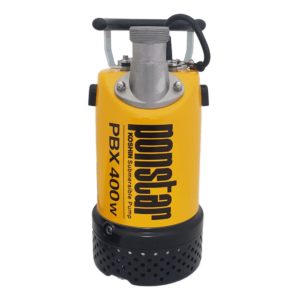
The Koshin Ponstar PBX range is a heavy-duty 2-inch submersible pump series built for construction sites and other jobs where the pump will see sandy water and is likely to run dry. Koshin designs the PBX specifically for sandy water, and fits it with an air valve and thermal protection, so it copes far better than most drainage pumps when the water runs out before anyone switches it off.
The air valve does two jobs. On start-up it lets trapped air escape, so the pump does not air-lock. When the water runs out, it keeps a flow of air moving through the pump to cool the motor, and a thermal protector cuts the power if the motor still overheats. Every model has twin mechanical seals (carbon on the motor side, silicon carbide on the pump side) in a lubricated chamber, a capacitor-start motor for strong starting torque, a 2-inch outlet with hose tail whose direction can be switched, and 10 metres of power cable.
PBX or PBX7: which do you need?
There are two pump sizes, each in four versions. The PBX has a 400 W motor and delivers up to 310 litres per minute, with a maximum head of 9.5 metres. The PBX7 has a 750 W motor, so it moves slightly more water (330 l/min) but lifts it much higher, to 15 metres. Choose the PBX7 when you need to lift water out of a deep excavation, push it a long way along a hose, or discharge it uphill; the PBX is enough for most sumps, trenches and flooded areas.
The number after the model name gives the voltage: 55022 is 230v mains and 55011 is 110v for site transformers. Performance is the same on either, but the 110v versions draw twice the current, and the 110v PBX7 draws 12 A, so check your transformer can supply it alongside anything else running.
Manual or automatic. Manual pumps run whenever the power is on. Automatic pumps come with a float switch that starts the pump as the water rises and stops it as the level falls, which is the better choice for unattended sumps and overnight running. The float can also be bought separately to convert a manual pump later.
| Model | Voltage | Operation | Max Flow (l/min) | Max Head (m) | Motor Output (W) | Current (A) |
|---|---|---|---|---|---|---|
| PBX 55022 Manual | 230v | Manual | 310 | 9.5 | 400 | 4.2 |
| PBX 55022 Automatic | 230v | Automatic | 310 | 9.5 | 400 | 4.2 |
| PBX 55011 Manual | 110v | Manual | 310 | 9.5 | 400 | 8.1 |
| PBX 55011 Automatic | 110v | Automatic | 310 | 9.5 | 400 | 8.1 |
| PBX7 55022 Manual | 230v | Manual | 330 | 15 | 750 | 6.0 |
| PBX7 55022 Automatic | 230v | Automatic | 330 | 15 | 750 | 6.0 |
| PBX7 55011 Manual | 110v | Manual | 330 | 15 | 750 | 12.0 |
| PBX7 55011 Automatic | 110v | Automatic | 330 | 15 | 750 | 12.0 |
Motor output and current are Koshin’s published figures. All eight models have a 2-inch outlet and 10 metres of cable. Click through to any model above for full specifications and the performance curve.
Showing all 8 results
 Heavy-duty 2-inch submersible pump for sandy site water, manual operation, 230v. Up to 310 l/min and 9.5 m head ...Read More
Flow Rate (l/min)
301 - 350 l/minMax Head (m)
0 - 10mVoltage
230v£374.11 +VAT- Heavy-duty 2-inch submersible pump for sandy site water, automatic with float switch, 230v. Up to 310 l/min and 9.5 ...Read More
Flow Rate (l/min)
301 - 350 l/minMax Head (m)
0 - 10mVoltage
230v£403.78 +VAT - Heavy-duty 2-inch submersible pump for sandy site water, manual operation, 110v. Up to 310 l/min and 9.5 m head ...Read More
Flow Rate (l/min)
301 - 350 l/minMax Head (m)
0 - 10mVoltage
110v£374.11 +VAT - Heavy-duty 2-inch submersible pump for sandy site water, automatic with float switch, 110v. Up to 310 l/min and 9.5 ...Read More
Flow Rate (l/min)
301 - 350 l/minMax Head (m)
0 - 10mVoltage
110v£403.78 +VAT - Heavy-duty 2-inch submersible pump for sandy site water, manual operation, 230v. Up to 330 l/min and 15 m head ...Read More
Flow Rate (l/min)
301 - 350 l/minMax Head (m)
11- 20mVoltage
230v£486.58 +VAT - Heavy-duty 2-inch submersible pump for sandy site water, automatic with float switch, 230v. Up to 330 l/min and 15 ...Read More
Flow Rate (l/min)
301 - 350 l/minMax Head (m)
11- 20mVoltage
230v£515.56 +VAT - Heavy-duty 2-inch submersible pump for sandy site water, manual operation, 110v. Up to 330 l/min and 15 m head ...Read More
Flow Rate (l/min)
301 - 350 l/minMax Head (m)
11- 20mVoltage
110v£486.58 +VAT - Heavy-duty 2-inch submersible pump for sandy site water, automatic with float switch, 110v. Up to 330 l/min and 15 ...Read More
Flow Rate (l/min)
301 - 350 l/minMax Head (m)
11- 20mVoltage
110v£515.56 +VAT
Where to Use Koshin Ponstar PBX Pumps
The PBX is a contractor’s pump. Excavations, foundation trenches, lift pits, service trenches and basements under construction fill with water that carries sand and fine grit, and the pump is often left running while the crew gets on with something else. That is where the dry-running protection earns its money: if the water is cleared before the pump is switched off, the air valve keeps the motor cool instead of letting it cook. On soft ground, stand the pump on a board or block so it does not sink into the sand it is meant to be pumping.
It is also a good flood and standby pump for facilities teams, plant hire fleets and maintenance departments, clearing flooded cellars, plant rooms, car park sumps and lift shafts. Our guide to flood pumps covers what to keep on standby. For a lighter 2-inch option at 260 l/min, the Koshin Ponstar PX range shares the same voltage and float options.
Know the limits before you buy. Koshin rates the PBX for sandy water and clean water between 5 and 40°C. It is not designed for heavy silt, clay or thick mud, sewage, salt water, oil or chemicals. For water with larger solids, see our dirty water pumps, and if you are unsure which type you need, our explainer on what a dirty water pump is sets out the differences.
Frequently Asked Questions
Can the Ponstar PBX really run dry?
It is designed to survive it. When the water runs out, air is drawn through the pump and out of the air valve, which keeps the motor cool, and a thermal protector switches the motor off if it still overheats. That makes it far more forgiving than a standard drainage pump on an unattended job. Running dry is still not a normal duty, so an automatic model or a float switch is the better answer for long or overnight running.
What is the difference between the PBX and the PBX7?
Motor size and head. The PBX has a 400 W motor, delivers up to 310 l/min and lifts to 9.5 m. The PBX7 has a 750 W motor, delivers up to 330 l/min and lifts to 15 m. Flow is similar at low lift, so the PBX7 is worth the extra when you need to lift water out of a deep hole, pump it uphill or push it along a long hose.
Can I run a PBX from a generator?
Yes, but size the generator properly. Koshin advises a generator with three to five times the pump’s power consumption, because the motor draws about three times its running current as it starts. That means roughly 2 to 3.5 kVA for a PBX and 4 to 6 kVA for a PBX7. An undersized generator lets the voltage sag, which can stop the pump starting or trip its thermal protector.
How does the automatic float switch work?
The float hangs from the pump on its cable. It switches the pump on when the water rises to roughly 350 to 870 mm, depending on how much cable you leave free, and off again when the level drops to roughly 100 to 230 mm. If you have a manual PBX or PBX7, the PBX/PBX7 MAC3 float converts it to automatic operation.
How deep can the pump be submerged?
Koshin rates the PBX series for use up to 5 metres below the water surface (7 metres on some versions). Lower it on a rope tied to the handle, never by the cable or hose, and keep the open end of the delivery hose above the water level so water cannot siphon back when the pump stops.
What hose fits the PBX outlet?
Every model has a 2-inch (50 mm) outlet supplied with a hose tail, so it takes standard 2-inch layflat or suction hose, and the discharge direction can be switched to suit how the hose runs. On long runs, friction in the hose reduces the flow at the far end; our guide to pump discharge pipe sizing explains how to allow for it, and our guide to pump head and flow rate shows how to read the performance curve on each model page.
If you would like help choosing between the PBX and PBX7, or sizing a pump, generator or float for a particular site, call the AES Rewinds team on 01252 515169 or email sales@aesrewinds.com. You can also compare the full Koshin range or browse all drainage pumps.
Need help? Got a question?
Give us a call on 01252 515169, email or Fill out the form below and we will be in touch.