
Specify a pump incorrectly and you’ll pay for it twice — once at purchase, and again in wasted energy, premature failure, and inadequate performance. The two numbers that matter most in any pump specification are head and flow rate, yet they’re frequently misunderstood or oversimplified.
This guide explains both concepts clearly, shows you how to calculate total dynamic head (TDH) for a real system, and explains how to use a pump performance curve to find the right pump for your application. Whether you’re a facilities manager sizing a drainage system, a contractor specifying a booster pump, or a buyer replacing ageing plant, understanding these fundamentals will save you time and money.
What Is Pump Head?
Put simply, head is the height to which a pump can raise a fluid, measured in metres. It’s the standard unit used to describe a centrifugal pump’s energy output, and it has one important advantage over pressure (measured in bar or psi): head is independent of the fluid’s density.
Because of this, it doesn’t matter whether you’re pumping clean water or heavy sludge — a pump will lift both to the same head height, though it will require more power to move the denser fluid. Grundfos, one of the world’s largest pump manufacturers, describes this as the reason head is preferred over pressure when specifying centrifugal pumps — the performance figures hold true regardless of what’s in the pipe.
Head is defined as the mechanical energy of the flow per unit weight, expressed as a column height of water in metres. When you see a pump rated at “20 metres head,” that means it can lift water vertically 20 metres under ideal conditions — no pipe friction, no bends, no fittings.
In reality, of course, those conditions never exist. That’s why the number you actually need is Total Dynamic Head (TDH), which accounts for all the real-world losses in your system. More on that in the calculating total dynamic head section.
The Relationship Between Head and Pressure
Head and pressure are closely related but not the same thing. A practical rule of thumb: every 10 metres of head is approximately equivalent to 1 bar of pressure (more precisely, 10.2 metres = 1 bar for water at normal temperature). If your system is specified in bar, multiply by 10.2 to convert to metres of head.
This relationship shifts slightly with fluid density and temperature, which is another reason pump engineers prefer to work in head when dealing with centrifugal pumps — the figures remain consistent regardless of what’s being pumped.
What Is Flow Rate?
Flow rate (also called pump capacity) is the volume of fluid a pump moves in a given time. In the UK, the standard units for industrial and commercial pump specifications are:
- m³/h (cubic metres per hour) — most common for larger commercial pumps
- l/min (litres per minute) — common for smaller pumps and commercial-scale applications
- l/s (litres per second) — used in civil and drainage engineering contexts
A critical point that catches many buyers out: a pump’s flow rate is not a fixed figure — it changes depending on the head it’s working against. The higher the head, the lower the flow rate the pump will deliver. You’ll find the full expression of this relationship in the pump performance curve section below.
How Much Flow Rate Do You Need?
Before selecting any pump, you need to establish your required flow rate — the volume of fluid that must move through your system in a given time. For drainage and dewatering applications, this typically means:
- Calculating the volume of water that needs to be removed (or supplied)
- Deciding on the acceptable time window to do so
- Dividing volume by time to get your required flow rate
Worked example: A basement sump pit holds approximately 500 litres. You want to empty it within 15 minutes in a flood event.
Required flow rate = 500 ÷ 15 = 33 litres per minute (approximately 2 m³/h)
In practice, always add a safety margin of at least 10–15% to account for efficiency losses and the possibility of peak inflow exceeding your estimate. For detailed guidance on sizing drainage applications, see our basement sump pump guide or our complete guide to sump pump sizing.
Calculating Total Dynamic Head (TDH)
This is where pump specification gets serious — and where many buyers make costly errors. Total Dynamic Head is the total equivalent height a fluid must be pumped, taking into account all the energy losses in the system. Many people treat it as simply the vertical height difference between source and outlet. That’s only one part of the picture.
TDH = Static Head + Friction Head Loss
Static Head
Static head is the straightforward component: the vertical distance the pump must lift the fluid from its source to its discharge point. If you’re pumping from a basement sump at -3 metres to a drain at ground level, your static head is 3 metres. If the outlet is at first-floor level (+4 metres), static head is 7 metres.
When calculating TDH, always assume the worst case — measure as if the source vessel is empty. In a sump pit, that means the pump running until the pit is nearly dry, which increases the lift distance as the water level drops.
Friction Head Loss
This is the energy lost as fluid forces its way through pipework. The further fluid travels and the more it encounters resistance from pipe walls, bends, and fittings, the more head is consumed before it reaches the outlet. This loss must be calculated and added to static head to arrive at your true TDH — which is the figure you should always use when selecting a pump.
The five most significant factors affecting friction loss are:
- Length of pipe — longer runs accumulate more resistance
- Diameter of pipe — wider bore reduces friction significantly; halving pipe diameter roughly quadruples friction loss at the same flow rate
- Velocity of flow — higher velocity increases friction; determined by flow rate and pipe bore
- Number and severity of bends — each bend and fitting adds resistance equivalent to a length of straight pipe
- Pipe material — rougher internal surfaces (e.g. corroded steel) increase friction compared to smooth plastic
For most commercial pump sizing, friction loss is estimated using manufacturer friction loss tables or an online head loss calculator. As a rough guide for clean water in smooth bore pipe:
| Pipe Diameter | Flow Rate | Approximate Friction Loss per 10m of Pipe |
|---|---|---|
| 50mm | 5 m³/h | ~0.25m |
| 75mm | 10 m³/h | ~0.20m |
| 100mm | 20 m³/h | ~0.18m |
| 100mm | 40 m³/h | ~0.55m |
Note: These figures are approximate for smooth bore pipe. Always use manufacturer friction loss charts for accurate specification, and add equivalent lengths for bends, valves, and fittings.
A Worked TDH Example
A contractor needs to pump dirty water from a construction site excavation to a drainage point on site. The parameters are:
- Excavation depth: 4 metres (static head)
- Horizontal pipe run: 30 metres
- Pipe diameter: 75mm
- Two 90° bends, one gate valve
- Required flow rate: 15 m³/h
Static head: 4m
Friction loss calculation:
- Friction in 30m of straight pipe at 15 m³/h through 75mm pipe ≈ 0.6m
- Equivalent length for two 90° bends and one gate valve: approximately 5m of additional pipe ≈ 0.1m
- Total friction head: approximately 0.7m
TDH = 4m + 0.7m = 4.7m
This contractor would look for a dirty water pump capable of delivering 15 m³/h at approximately 5 metres head — and would then size up 10–15% to around 17 m³/h at 5.5m for a safe working margin. For more on dirty water pump selection for construction applications, see our guide on what is a dirty water pump.
Reading a Pump Performance Curve
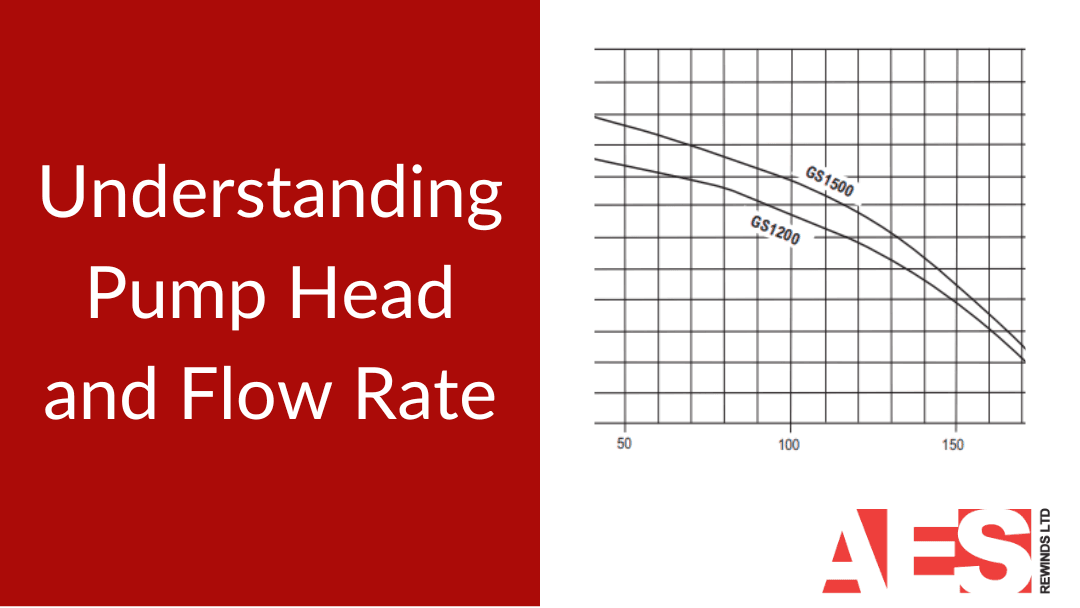
The pump performance curve (or H-Q curve) is the single most important document when selecting a pump. Once you understand how to read it, pump selection becomes far more straightforward.
The curve plots head (H) on the vertical axis against flow rate (Q) on the horizontal axis, showing how a pump behaves across its full operating range. Grundfos publishes detailed guidance on reading pump curves, which is worth reviewing alongside any datasheet.
What the Curve Shows
At the far left of the curve, where flow rate is zero, the pump is generating its maximum head — this is known as the shut-off head, the point at which the pump is working against a completely closed system. Moving right along the curve, as flow rate increases, the available head decreases. The rightmost point represents maximum flow at minimal head resistance.
This inverse relationship between head and flow is the defining characteristic of a centrifugal pump: the more freely water can flow through the system, the faster it moves; the harder the pump must work against resistance, the less it delivers.
Pump curves tested to ISO 9906 — the international standard for hydraulic performance acceptance testing of rotodynamic pumps — will carry clearly defined tolerance grades for head, flow, and efficiency. When comparing pumps, checking that performance data is certified to ISO 9906 gives you confidence the figures are independently verifiable.
Finding Your Duty Point
The duty point is where your system requirements intersect with the pump’s performance curve — the point that defines how the pump will actually perform in your installation.
To find it:
- Calculate your required flow rate (see the flow rate section above)
- Calculate your TDH (see the TDH section above)
- Plot those two values on the pump performance curve
- The intersection is your duty point
Your duty point should ideally fall near the pump’s Best Efficiency Point (BEP) — typically around 70–80% along the curve from left to right. Operating consistently near the BEP reduces energy consumption, limits mechanical stress, and extends service life. Our A-Z of pump terminology covers BEP and other key performance terms in more detail.
Why Operating Away from BEP Is Costly
An oversized pump running well below its design point wastes energy and accelerates wear, while an undersized pump that can never reach its duty point will be overworked and short-lived. For a facilities manager responsible for plant running costs, operating even a single pump at poor efficiency can mean hundreds of pounds in unnecessary energy expenditure per year.
Atlas Copco notes that total head is a more reliable performance indicator than pressure precisely because it accounts for the full picture of system resistance — suction conditions included. This makes TDH the right figure to use when matching a pump to its duty point.
Common Head Calculation Mistakes to Avoid
Even experienced specifiers make errors here. The most frequent pitfalls:
Confusing static head with TDH. Static head is just the vertical lift. TDH includes friction losses — in a system with long runs and multiple bends, friction can add 20–30% or more to the static head figure.
Ignoring suction-side losses. If your pump is positioned above the fluid source (as with many surface-mounted installations), suction lift must be factored into your TDH calculation. See our guide to self-priming pumps for more on suction-side considerations.
Using nominal pipe diameter instead of internal bore. Friction calculations require the internal bore, which is always smaller than the nominal (labelled) pipe size. Using the wrong figure will underestimate friction losses.
Forgetting fittings and valves. In systems with many directional changes, resistance from fittings can actually exceed pipe friction. Each elbow, gate valve, and check valve adds equivalent pipe length that must be included.
Sizing to minimum requirements. Always add 10–15% to your calculated TDH and flow rate. This accounts for efficiency losses over time, future system changes, and natural variability between specified and real-world performance.
How Head and Flow Rate Apply to Different Pump Types
The relationship between head and flow rate plays out differently depending on the application. Here’s how it shapes selection across common commercial pump categories:
Booster Pumps
Booster pumps are selected almost entirely on head and flow rate. The primary goal is delivering sufficient pressure at the required flow rate to every outlet in a building or system. Under Ofwat’s Guaranteed Standards Scheme, UK water companies are only required to maintain a minimum of 7 metres static head (0.7 bar) at the communication pipe. In multi-storey commercial buildings, that mains pressure is often wholly inadequate — every additional floor requires approximately 10kPa per metre of height, meaning a five-storey building may need 50kPa or more beyond mains pressure to serve upper floors reliably. A booster pump that delivers adequate flow but insufficient head will result in poor pressure at upper floors or distant outlets. Our booster pump selection guide covers this in detail. Browse our booster pump range to compare specifications.
Drainage and Sump Pumps
For sump pumps and drainage pumps, the head requirement is typically modest — often under 10 metres — but flow rate is critical. The pump must clear water quickly enough to prevent flooding. See our guide to sump pumps for sizing guidance specific to drainage applications.
Sewage Pumps
Sewage pumps introduce a further complication: the fluid contains solids that increase effective resistance through the system, making accurate TDH calculation especially important. Undersizing a sewage pump’s head capacity is a common cause of blockages and pump overload. Our guide to choosing a sewage pump covers the interplay between head, flow, and solids handling in detail.
Borehole and Well Pumps
Borehole pumps operate at significant depth, meaning static head alone can be substantial — often 20–60 metres or more depending on the water table. Friction losses in the rising main (the pipe from pump to surface) must be calculated carefully, as these accumulate over long vertical pipe runs. See our well pump selection guide for borehole-specific TDH guidance.
Recommended Pumps from AES Rewinds
Getting head and flow rate right starts with having access to pumps specified with accurate, complete performance data. At AES Rewinds, we stock a comprehensive range of industrial and commercial pumps across all major categories, with full performance curves available for each product.
Browse our pump ranges:
- Dirty water pumps — for construction, drainage, and dewatering applications
- Sewage pumps — for below-ground waste water systems
- Booster pumps — for pressure boosting in commercial and industrial buildings
- Sump pumps — for basement drainage and flood protection
- Borehole and well pumps — for high-head water extraction applications
Our team can help you work through TDH calculations and match a pump to your duty point. Contact us for expert advice on any application.
Frequently Asked Questions
What is the difference between pump head and pressure?
Head and pressure are related but distinct. Pressure varies depending on the fluid’s density, whereas head is independent of it — a pump will lift water and dense slurry to the same head height, though it will require more power for the denser fluid. Head is expressed in metres and is the standard unit for specifying centrifugal pumps. As a quick conversion for water: 10 metres of head equals approximately 1 bar of pressure.
How do I calculate total dynamic head for my system?
Add your static head (the vertical distance from fluid source to discharge point, measured worst-case with the source vessel empty) to your friction head loss (calculated using friction loss tables based on your pipe diameter, length, material, flow rate, and fittings). The result is your TDH. See the TDH calculation section above for a worked example.
What happens if I choose a pump with insufficient head?
A pump without enough head to overcome your system’s TDH will fail to deliver the required flow rate — or may not move fluid at all in extreme cases. It will also tend to operate at the far right of its performance curve, which increases the risk of cavitation, motor overload, and accelerated wear.
What is a pump duty point?
The duty point is the intersection of your system’s requirements (your required head and flow rate) with the pump’s performance curve. It defines how the pump will actually operate in your installation. For efficient, reliable performance, your duty point should fall close to the pump’s Best Efficiency Point (BEP). See the pump performance curve section for how to identify it.
Should I size my pump exactly to my calculated requirements?
No — always build in a margin. Size to 10–15% above your calculated TDH and flow rate. This accounts for efficiency degradation over time, variability in friction calculations, and the possibility of future system changes. A pump running slightly below its maximum capacity will also tend to run more quietly and last longer than one straining at its limit.
What is the shut-off head?
The shut-off head is the maximum head a pump can produce at zero flow — the leftmost point on the performance curve. In normal operation a pump should not be run at or near shut-off head for extended periods, as this can cause overheating and instability. Pump manufacturers typically advise keeping operating head within 110–120% of the rated duty point head.
Does head change if I pump a denser fluid like slurry?
The head in metres remains the same for a given pump operating at the same speed — the pump will lift slurry to the same height as water. However, the pressure generated (in bar) will be higher because the fluid is heavier, and the motor will consume more power. For very dense or viscous fluids, request derated performance curves from the pump manufacturer before specifying.
How does pipe diameter affect my pump selection?
Pipe diameter has a major effect on friction losses. Smaller bore pipe creates greater resistance for a given flow rate, increasing your TDH and pushing you towards a higher-specified pump. As a rough rule, halving the pipe diameter roughly quadruples the friction loss at the same flow rate. Where practical, upsizing pipework can reduce TDH requirements and allow selection of a smaller, more energy-efficient pump.
Key Takeaways
- Head is the vertical height a pump can raise fluid, measured in metres and independent of fluid density — making it the standard unit for centrifugal pump specification.
- Flow rate (m³/h or l/min) is how much fluid moves through the pump per unit time. It decreases as head increases — the two are inversely related on the performance curve.
- Total Dynamic Head (TDH) is what you actually need to calculate: static head plus friction losses from pipework, bends, valves, and fittings. Never specify a pump against static head alone.
- The pump performance curve plots head against flow rate across the full operating range. Your duty point should fall near the Best Efficiency Point for reliable, energy-efficient operation.
- Always size to 10–15% above your calculated requirements, and always obtain full ISO 9906-certified performance curve data before purchasing.
Related Articles
- How to Choose the Right Booster Pump — Applies head and flow rate principles to pressure boosting applications
- What Size Sump Pump Do I Need? Complete Guide — Practical sizing guidance for drainage applications
- How to Choose a Sewage Pump — How head and flow rate interact with solids handling in sewage systems
- A-Z of Pump Terminology — Reference guide covering BEP, NPSH, TDH, and all key specification terms
- Self-Priming Pumps Guide — Covers suction-side head considerations for surface-mounted installations