
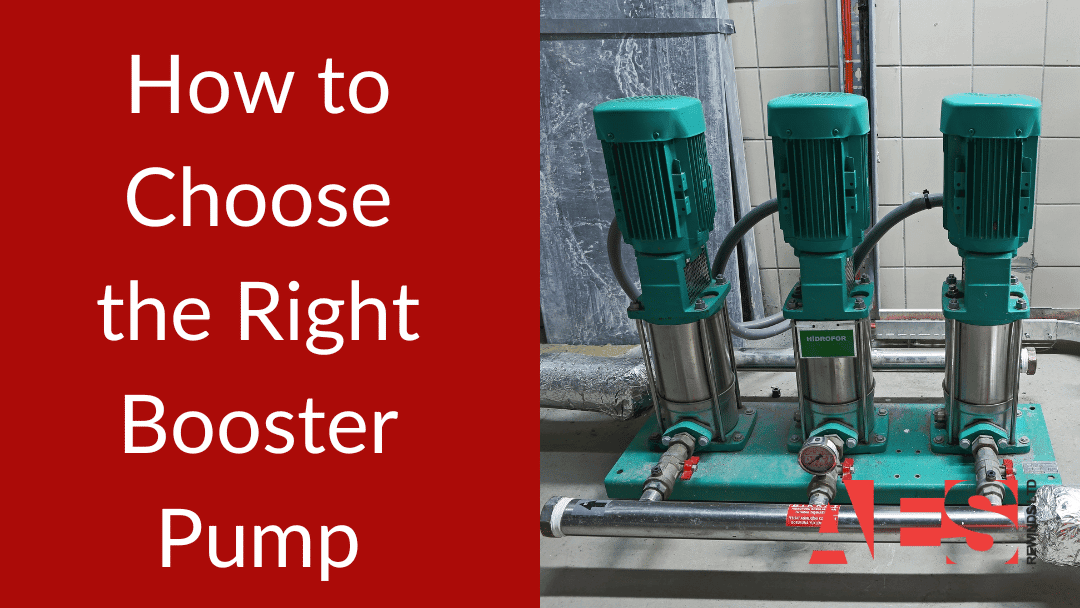
Low water pressure rarely announces itself politely. It shows up as a weak shower on the top floor of a building, a drip where there should be flow, or heating equipment that cuts out because the inlet pressure has fallen below its minimum operating threshold. A booster pump resolves the problem by adding energy to the system, lifting pressure from wherever it currently sits to wherever it needs to be.
Choosing the wrong one is an easy mistake to make. Undersize it and you are back to the same problem. Oversize it and you waste energy, risk damaging downstream fittings, and introduce short-cycling that wears the pump out prematurely. This guide walks through the sizing process properly, with a calculator to help you arrive at the right specification.
What a Booster Pump Actually Does
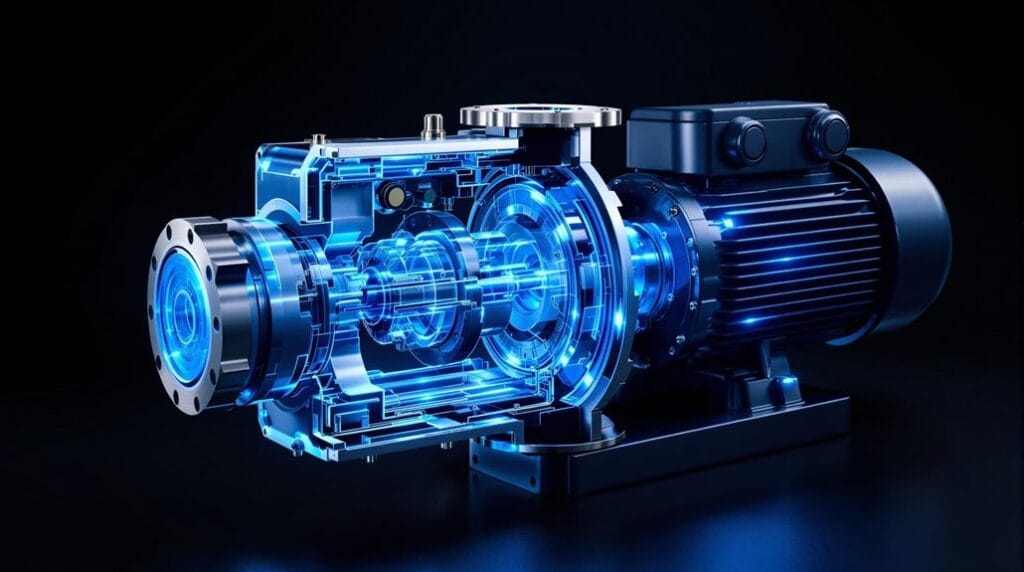
A booster pump is a centrifugal pump installed in a pipework system to increase pressure at the point of use. Unlike a borehole or sump pump, which moves water from one place to another, a booster pump takes water that is already flowing and pushes it harder. It sits between the incoming supply and the distribution system, maintaining a set outlet pressure regardless of what the inlet delivers.
Most booster pumps sold for UK commercial and residential applications are either single-stage or multi-stage centrifugal units with an integrated pressure sensor and electronic controller. The controller monitors system pressure continuously and adjusts pump speed, or starts and stops the pump, to hold pressure at the target setpoint. Variable-speed units do this smoothly and efficiently; fixed-speed units cycle on and off against a pressure switch.
For a broader introduction to how pumps generate pressure and the relationship between head and flow rate, see our guide on understanding pump head and flow rate.
When Do You Need a Booster Pump?
The clearest indication is measured pressure. Attach a pressure gauge to an outdoor tap or the incoming supply pipe and take a reading during peak usage. The typical target for a UK building is 2.5 to 4 bar at the point of use. Below 2 bar, most showers perform poorly and some appliances will not operate at all. Above 4 bar, you risk accelerated wear on seals and fittings.
Low mains pressure is the most common cause of the problem, particularly in older distribution networks, properties at the end of a supply run, or buildings at higher elevation than the local water main. Under Ofwat’s Guaranteed Standards Scheme, water companies are only obliged to maintain 7 metres static head (0.7 bar) at the communication pipe. That baseline is frequently insufficient for anything other than ground-floor use.
Multi-storey buildings face a compounding issue: every metre of height loses approximately 0.1 bar of pressure. A five-storey building needs around 0.5 bar of additional pressure just to overcome elevation, before any pipe friction losses are accounted for. For commercial properties, this makes a booster pump less a convenience and more a necessity.
💡 Pro tip: Always measure pressure at the problem point, not at the incoming supply. A building may have adequate mains pressure at the boundary but significant losses through ageing pipework before water reaches the upper floors.
Calculating Your Booster Pump Requirements
Two figures drive booster pump selection: how much pressure you need to add, and how much flow the pump must sustain at that pressure. Getting both right before you look at products will save a significant amount of time and money.
Step 1: Establish Your Required Outlet Pressure
Start with the minimum pressure needed at the most demanding point in the system. For most commercial buildings, this is the highest fixture or the piece of equipment with the highest minimum inlet pressure requirement. Add the elevation head between the pump and that point (1 metre of height = 0.1 bar), plus an allowance for pipe friction (covered in the calculator below), plus the required residual pressure at the outlet.
A typical target for commercial hot and cold water systems in the UK is 2.5 to 3 bar at the highest outlet. For industrial process equipment, check the manufacturer’s minimum inlet pressure specification.
Step 2: Establish Your Required Flow Rate
Flow rate is the volume of water the pump must deliver per minute while maintaining the target pressure. In a building, this means estimating simultaneous peak demand: how many outlets or appliances are likely to be running at the same time?
A practical method for commercial buildings is to list all fixtures, assign each a demand unit from the table below, sum the demand units for the zone being served, and convert to litres per minute using the conversion in the same table. This approach, drawn from BS EN 806 loading units guidance, is more reliable than simply adding up maximum flow rates from each outlet.
| Factor | Fixed Speed | Variable Speed |
|---|---|---|
| Purchase cost | Lower | Higher |
| Energy consumption | Higher (runs at full speed) | 40–60% lower at part load |
| Pressure consistency | Varies between switch points | Held at setpoint continuously |
| Water hammer risk | Present on each start | Minimal (soft start) |
| Best suited to | Simple, steady demand | Variable demand, extended run hours |
For simultaneous peak demand, do not sum the full flow from every outlet. A building with 20 showers will not run all 20 at once. Use a diversity factor: in commercial accommodation, 40–60% simultaneous use is a reasonable assumption at peak times.
Step 3: Calculate the Required Pressure Boost
The required boost is the difference between your available inlet pressure and your required outlet pressure, adjusted for elevation and pipe losses. The calculator below works this through automatically.
Booster Pump Requirement Calculator
Booster Pump Requirement Calculator
Enter your system details to estimate the pressure boost and minimum flow rate required. Results are a starting point for pump selection — always confirm against manufacturer performance curves.
A Worked Example
A four-storey commercial office building has mains pressure measured at 1.2 bar at the incoming supply. The highest outlet is 12 metres above the pump location. There are 15 metres of 28 mm distribution pipe. Peak simultaneous demand is estimated at 80 l/min.
- Required outlet pressure: 2.5 bar
- Elevation loss: 12 x 0.1 = 1.2 bar
- Friction loss at 80 l/min through 15 m of 28 mm pipe: approximately 0.08 bar
- Total boost required: (2.5 – 1.2) + 1.2 + 0.08 = 2.58 bar
- Equivalent head: approximately 26 metres
- Minimum pump output: 80 l/min x 1.15 = 92 l/min at 26 m head
The specifier would look for a multi-stage booster pump set rated to deliver at least 90 l/min at 26 metres head, and would select a model whose duty point sits near the middle of the performance curve to allow headroom in both directions.
Fixed Speed vs Variable Speed
Most booster pumps sold today fall into one of two categories based on how they regulate output, and the choice has a significant effect on energy costs and system behaviour.
Fixed Speed Pumps
A fixed speed pump runs at a single motor speed whenever it is switched on. Pressure regulation is handled by a pressure switch: the pump starts when pressure drops below a set lower threshold and stops when it reaches the upper threshold. Between those two points, a pressure vessel (expansion tank) absorbs the difference, limiting how frequently the pump has to cycle.
Fixed speed units are simpler, less expensive, and straightforward to maintain. They suit applications with relatively consistent demand and where the pressure range between on and off is not too narrow. The main limitation is efficiency: the pump runs at full power whether you need a small trickle of flow or the maximum output, and frequent cycling shortens motor life.
Variable Speed Pumps
A variable speed pump (also called a variable frequency drive or VSD pump) uses an inverter to vary the motor speed in response to demand. The controller monitors system pressure continuously and adjusts speed to maintain the target setpoint precisely, with no on/off cycling at all under steady demand.
The energy savings are substantial. Because pump power consumption varies with the cube of motor speed, running at 70% speed uses roughly 34% of the energy of running at full speed. For a commercial building with a pump running eight or more hours a day, this typically translates to energy savings of 40–60% compared to a fixed speed equivalent.
Variable speed units are also gentler on the pipework. The gradual ramp-up of pressure on each start eliminates the water hammer that fixed speed pumps can produce, which matters in older buildings with soldered copper pipework.
| Factor | Fixed Speed | Variable Speed |
|---|---|---|
| Purchase cost | Lower | Higher |
| Energy consumption | Higher (runs at full speed) | 40–60% lower at part load |
| Pressure consistency | Varies between switch points | Held at setpoint continuously |
| Water hammer risk | Present on each start | Minimal (soft start) |
| Best suited to | Simple, steady demand | Variable demand, extended run hours |
For most commercial applications where the pump runs for extended daily periods, the additional cost of a variable speed unit is typically recovered within two to three years through energy savings.
Single-Stage vs Multi-Stage
The number of impeller stages determines how much pressure a pump can generate. A single-stage pump has one impeller and is suited to lower pressure boosts, typically up to around 3 bar. A multi-stage pump has multiple impellers in series, each adding a further increment of pressure, allowing total heads of 60 metres or more from a compact unit.
For most UK domestic and light commercial applications, a single-stage pump is sufficient. For multi-storey buildings, systems requiring more than 2.5 bar of boost, or longer distribution runs with significant friction losses, a multi-stage pump will be necessary. The borehole and irrigation pump categories at AES Rewinds use multi-stage designs for exactly this reason; the same principle applies to boosting applications.
Pump Sets and Redundancy
For commercial and critical applications, a single pump is a single point of failure. A booster pump set houses two or more pumps sharing a common manifold and control panel. Under normal demand, both pumps share the load, which keeps each one operating well within its capacity and extending service life. If one pump fails, the other takes over automatically without any interruption to supply.
Packaged twin-pump sets are available as a single, pre-plumbed unit ready for connection to incoming and outgoing pipework. For facilities managers specifying a system that must not fail during occupied hours, a twin-pump set is the appropriate specification, not a larger single pump.
⚠️ Important: A booster pump set must not be connected directly to a mains supply pipe without a break tank or approved backflow prevention device. Direct mains boosting is prohibited in most circumstances under the Water Supply (Water Fittings) Regulations 1999 without prior consent from the water supplier.
Installation Requirements
A booster pump is not simply a device you insert into a pipework run. A correctly installed system includes the pump itself, isolation valves on both inlet and outlet, non-return valves to prevent backflow, a pressure vessel to limit cycling frequency on fixed speed units, and a drain point for servicing. Variable speed sets typically integrate these into a packaged assembly, but it is worth confirming what is and is not included before purchase.
Location matters for noise. Fixed speed pumps produce a notable thump on start-up; variable speed units are significantly quieter but still generate motor noise during operation. In commercial buildings, plant rooms below occupied floors benefit from anti-vibration mounts and flexible pipe connections to limit transmission.
If you are replacing a like-for-like pump, note that pipework connections and pump orientation do not always match across brands or generations of the same brand. Confirm connection sizes and orientation before ordering. For guidance on related installation considerations, our post on how to calculate pump sizing for industrial applications covers the wider specification context.
Common Sizing Mistakes
The most frequent error is specifying a pump solely to provide enough pressure at the top floor without accounting for the flow rate the system needs to deliver simultaneously. A pump rated to 4 bar shut-off head may only deliver 1.5 bar at the required flow rate when you plot the operating point on the performance curve. Always check the curve at your required flow, not at zero flow.
Oversizing is equally common, particularly when replacing an existing pump. A pump that is too large for the system will short-cycle on a fixed speed installation (starting and stopping every few seconds), which destroys the motor winding rapidly. If your current pump short-cycles, the solution is rarely to fit a bigger pump. For guidance on the head and flow relationship and how to read performance curves, see understanding pump head and flow rate.
Ignoring inlet conditions is a third common issue. A booster pump cannot create pressure from nothing. If the inlet supply drops below the pump’s required minimum inlet pressure (typically 0.3 to 0.5 bar), the pump will cavitate or fail to prime. In buildings with very low mains pressure, a break tank and a separately sized transfer pump feeding the booster may be the correct solution.
Recommended Booster Pumps from AES Rewinds
At AES Rewinds, we stock a comprehensive range of booster pumps suitable for domestic, commercial, and light industrial applications, including fixed speed and variable speed single-pump and twin-pump set configurations.
Browse our range:
- Booster pumps — single and twin pump sets, fixed and variable speed, for all pressure and flow requirements
- Surface mounted pumps — self-priming options where suction-side installation is required
Our team can help you confirm your sizing calculations and identify the right product for your application. Contact us for specification support on any booster pump project.
Frequently Asked Questions
How do I calculate the size of booster pump I need?
Start by measuring your inlet pressure and identifying the pressure required at your highest or most demanding outlet. The difference between those two figures, plus any elevation loss (0.1 bar per metre of height) and pipe friction loss, gives you the required pressure boost in bar. Multiply by 10.2 to convert to metres of head. You then need to establish your peak simultaneous flow rate and find a pump whose performance curve delivers that flow at the required head. The calculator in this guide handles the pressure boost and friction calculation for you.
What pressure should a booster pump deliver?
The pump needs to deliver enough pressure to cover inlet pressure shortfall, elevation head, pipe friction, and residual pressure at the point of use. For most commercial buildings, the target at the highest outlet is 2.5 to 3 bar. For industrial process equipment, always check the manufacturer’s minimum inlet pressure specification — it is often higher than this.
Can I connect a booster pump directly to the mains?
In most cases, no. Direct mains boosting requires prior consent from your water supplier under the Water Supply (Water Fittings) Regulations 1999. The majority of commercial installations use a break tank to receive mains water, with the booster pump drawing from the tank. This approach also provides resilience if mains pressure drops or supply is interrupted.
What is short-cycling and why does it damage a pump?
Short-cycling occurs when a fixed speed pump starts and stops repeatedly over a short period, typically because the pressure vessel is undersized or the pump is too large for the demand. Each start draws a high in-rush current through the motor windings. Repeated short starts generate heat that the motor cannot dissipate quickly enough, degrading winding insulation and leading to premature failure. A variable speed pump eliminates this risk entirely by modulating speed rather than cycling on and off.
Do I need a separate pressure vessel with a variable speed booster pump?
Variable speed booster pumps significantly reduce or eliminate the need for a large pressure vessel because they respond to demand changes by adjusting motor speed rather than cycling on and off. Most packaged variable speed sets include a small vessel as part of the assembly for startup stabilisation, but the large tanks required with fixed speed installations are not needed.
How much energy does a booster pump use?
This varies enormously with pump size, hours of operation, and whether a fixed or variable speed drive is used. A fixed speed pump rated at 1.5 kW running for eight hours a day consumes approximately 4,380 kWh per year. A variable speed equivalent operating at part load for the same period might consume 40–60% less. For commercial installations where the pump runs continuously, the energy cost is a significant operating expense and the higher purchase cost of a variable speed set is usually justified within two to three years.
What is the difference between a single-stage and multi-stage booster pump?
A single-stage pump has one impeller and is suitable for lower boost requirements, typically up to around 3 bar. A multi-stage pump has multiple impellers in series, each adding pressure incrementally, allowing high total heads from a physically compact unit. Multi-stage pumps are the correct choice for tall buildings, long distribution runs, or applications requiring a boost of more than 2.5 to 3 bar.
How do I know if my low pressure problem is the mains supply or my internal pipework?
Measure pressure at the incoming supply point (ideally at the stopcock just inside the building) and again at the problem outlet. If pressure at the supply point is already below 1 bar, the issue is with mains supply and a booster pump is the right solution. If supply pressure is adequate but pressure drops significantly between the supply point and the outlet, the problem is internal — likely undersized or corroded pipework. In this case, improving the pipework may solve the issue without the need for a pump.
Key Takeaways
- Booster pump selection requires two figures: the required pressure boost in bar (or equivalent metres head) and the peak flow rate the pump must sustain at that pressure.
- Required boost = (target outlet pressure minus inlet pressure) + elevation head loss + pipe friction losses. The calculator above handles this calculation.
- Always check the pump’s performance curve at your required flow rate, not at zero flow. Shut-off head and duty-point head are not the same figure.
- Variable speed pumps cost more upfront but deliver 40–60% energy savings at part load and eliminate short-cycling, making them the better choice for most commercial applications with extended run hours.
- For critical supply applications, a twin-pump set provides redundancy. A single pump is a single point of failure.
- Direct mains boosting requires water supplier consent. Most commercial installations use a break tank arrangement.
Related Articles
- Understanding Pump Head and Flow Rate — how to read a performance curve and identify your duty point
- How to Calculate Pump Sizing — the full sizing framework for any commercial pump application
- What Is a Booster Pump and When Do You Need One? — introduction to booster pump applications and types
- A-Z of Pump Terminology — definitions for head, TDH, duty point, BEP, and other key terms
- How to Increase Water Pressure — practical guide to diagnosing and resolving low pressure problems